

There are two ways to end up on this page, and they are opposites. Either you're a teacher, editor, or hiring manager staring at a submission that reads a little too smoothly and you want to know what actually wrote it. Or you're a writer who was accused of using AI on something you wrote yourself, and you want to know how a machine could possibly get that so wrong.
GPTZero is the tool at the center of both stories. It's the original AI detector — built in January 2023 by Princeton student Edward Tian — and it's now the category leader by a distance, with a research partner list that includes the Associated Press and the American Federation of Teachers. It's also, as of June 2026, being acquired. This GPTZero review covers what it detects well, where it still gets things wrong, what it costs after the word-budget math, and what joining Superhuman actually changes.
- It is genuinely the most accurate detector — with an asterisk: independent RAID benchmarking puts it top of the field, but every detector's accuracy collapses on heavily paraphrased text, and GPTZero is no exception.
- It stopped being just a detector: the 2026 suite includes a hallucination detector for fake citations, writing replay for proving authorship, plagiarism and grammar checking, and AI Vision for spotting AI as you browse.
- It's joining Superhuman: announced June 23, 2026. Same product, more resources, and AI detection heading into email inboxes via Superhuman and Grammarly's user base.
- The free tier is unusually usable: 10,000 words a month with no credit card — enough to settle most one-off questions without ever paying.
- A score is evidence, never proof: the false-positive problem is real, documented, and the single most important thing to understand before you act on a result.
Quick Summary
The Category Leader, Honestly Assessed
No AI detector is a lie detector, and the ones that market themselves that way are the ones to avoid. GPTZero is the best of a genuinely difficult category: it wins independent benchmarks, it's the only major detector explicitly de-biased for ESL writers, it explains why a passage looks machine-written instead of just flashing a percentage, and it's expanded into hallucination detection and authorship verification that are arguably more useful than the detection itself. Where it loses points is unavoidable physics — paraphrasing tools degrade accuracy, and a confident-looking score in an academic dispute carries more weight than the underlying math deserves.
Quick Pros & Cons
- Top of the independent RAID benchmark for detection accuracy.
- Sentence-level highlighting explains which passages triggered the score.
- The only major detector explicitly de-biased for ESL writers.
- Hallucination detector catches fabricated citations — a rare, valuable tool.
- Writing replay lets an accused writer prove their process.
- Free tier is genuinely usable at 10,000 words a month.
- Accuracy drops sharply on text run through humanizer tools.
- Independent classroom studies report far higher false positives than the vendor's ~1%.
- Word allowances reset monthly — unused words don't roll over.
- Chrome extension, AI Vocabulary, and larger batches need a paid plan.
- Monthly billing is roughly 45% more expensive than annual.
- Uploading student or client work to a third party raises real privacy questions.
What GPTZero Actually Does
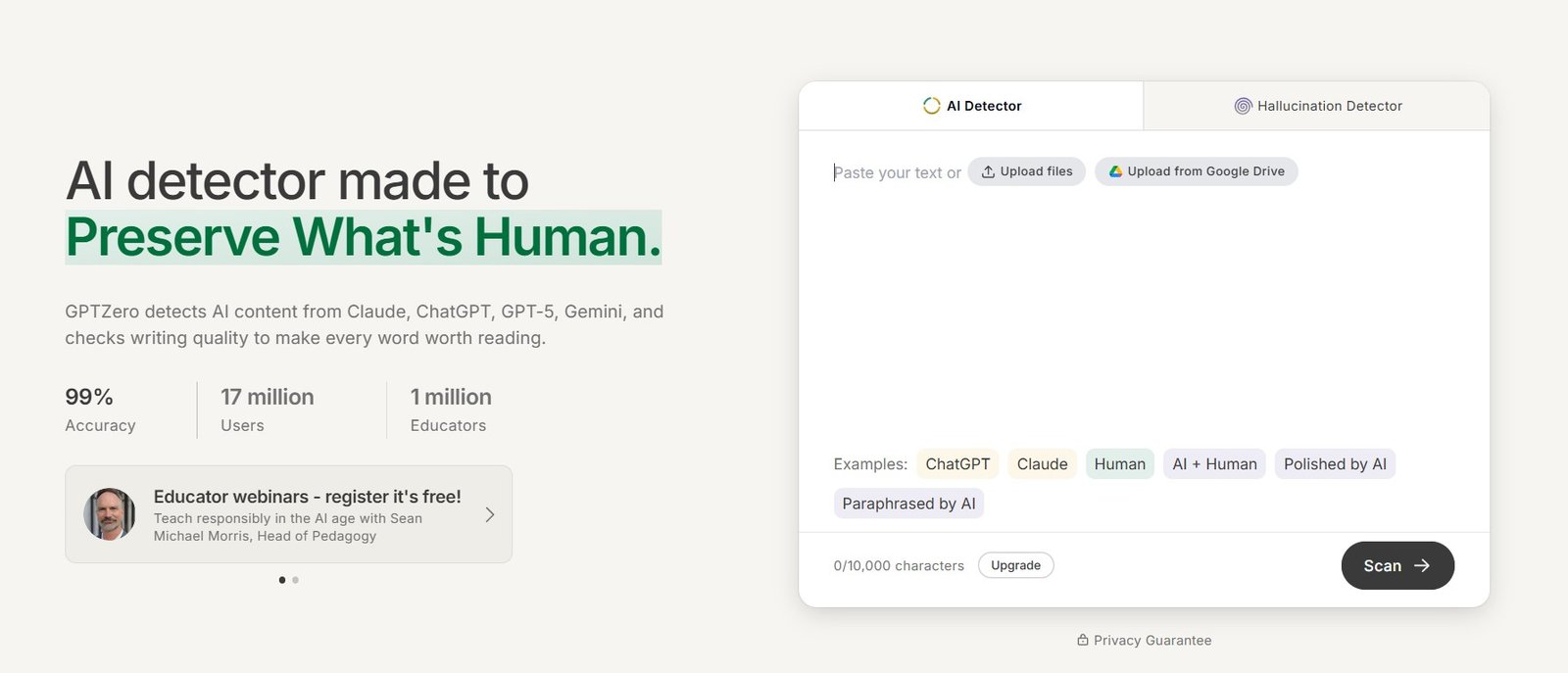
At its simplest: you paste text or upload a document, and GPTZero returns a probability that it was machine-written — plus colour-coded highlighting showing exactly which sentences drove that number. That last part is the differentiator. Most detectors hand you a bare percentage. GPTZero shows its working, which is the difference between a number you can discuss with a student and a number you can only accuse them with.
Underneath, the model looks at the signals that separate machine prose from human prose: perplexity (how predictable each word is given the ones before it), burstiness (how much sentence length and rhythm vary — humans write unevenly, models don't), and stylistic markers like the vocabulary that language models over-reach for. It's trained across ChatGPT and GPT-5, Claude, Gemini, Llama, and DeepSeek rather than tuned to one vendor, with training data refreshed as new models ship.
The 2026 product is much wider than that core scan, and the additions are arguably more defensible than detection itself. The hallucination detector checks whether cited sources actually exist — the feature behind multiple Financial Times investigations into professional AI use, and the one most likely to save a lawyer or researcher from public embarrassment. Writing replay records the drafting process so a writer can demonstrate authorship rather than argue about a score. AI Vision flags likely AI content as you browse. There's also plagiarism checking, grammar checking, and expert writing feedback layered on top.
The 2026 News: GPTZero Is Joining Superhuman
On June 23, 2026, GPTZero announced it plans to join Superhuman — the company that now sits behind Grammarly and Superhuman Mail. The connection came through Grammarly co-founder Alex Shevchenko and led to Superhuman CEO Shishir Mehrotra; GPTZero's team has described the deal as a "trampoline" arrangement rather than an absorption, with the smaller company keeping its product and gaining resources.
What it means practically, based on GPTZero's own commitments:
- Nothing breaks for existing users. The detection, hallucination, and writing-replay suite continues as-is, with more engineering behind it.
- Detection is heading into email. The most-requested feature has been AI detection inside the inbox — and Superhuman brings an email user base in the millions across Grammarly and Superhuman Mail.
- Deeper LMS and ATS integrations are promised, alongside upgrades to the Chrome extension and mobile/desktop apps.
- More classroom resources for teaching, grading, and designing assignments in an AI-saturated environment.
The strategic logic is easy to read: when roughly half of new online content is machine-written, verified human work becomes the scarce thing — and an authenticity layer is far more valuable embedded in the tools where writing actually happens than as a website you remember to visit. If you're evaluating GPTZero for a multi-year institutional contract, the acquisition is a stability signal rather than a risk, but it's worth asking sales how pricing and data handling are committed post-close.
Core Features
How Accurate Is GPTZero, Really?
This is the only question that matters, and the honest answer has three different numbers depending on what you feed it. GPTZero markets 99% accuracy; independent testing supports the headline while showing exactly where it degrades.
Read the bottom bar carefully, because it's the one that decides whether detection is useful in your context. Text pushed through a paraphrasing or "humanizer" tool defeats detection far more often than raw model output does — and that's not a GPTZero flaw so much as the fundamental limit of the category. If you want to understand the other side of that arms race, our StealthGPT review covers what these tools actually do to text.
Practically, treat the score as three bands rather than a number:
The False-Positive Problem (Read This Before You Accuse Anyone)
GPTZero handles this better than its competitors and is the only major detector to publish ESL de-biasing work, targeting a ~1% false-positive rate for non-native English writing. That's a meaningful, deliberate effort. It does not make the problem disappear.
- Independent classroom research has reported far higher false-positive rates than vendor figures — one widely cited study found rates as high as 18% on real student work. Whose writing gets misflagged is not random.
- ESL writers carry the most risk. Earlier Stanford research found detectors systematically misclassifying non-native English writing, and the issue has since featured in litigation. Clean, formal, grammatically careful prose is exactly what these models read as machine-like.
- Grammar tools muddy the signal. Text heavily edited by writing assistants can drift into the flagged range even when the ideas and drafting are entirely human.
- Short text is unreliable. Accuracy improves with length. A paragraph is not enough to conclude anything; a full document is a far better basis.
- A score is not evidence of misconduct. GPTZero says this itself: results shouldn't be used as a final verdict or to punish. Use it to start a conversation, corroborated by drafts, version history, or writing replay.
If you're on the receiving end of a false accusation, the practical defence is process evidence, not argument: document version history, drafts with timestamps, and GPTZero's own writing replay all demonstrate how a piece was made. Writers doing serious long-form work in a dedicated environment — see our Scrivener review — usually have this trail already without realising it.
How It Works in Practice
Step 1: Submit the text
Paste directly or upload a file. The free tier caps each scan at 10,000 characters; a free account raises the ceiling, and paid plans unlock batch uploads for marking whole classes or content queues.
Step 2: Read the highlighting, not the headline
The overall percentage is the least useful output. The sentence-level colour coding tells you whether one pasted paragraph triggered the flag or the whole piece reads machine-written — a completely different conversation.
Step 3: Corroborate before acting
Run Advanced Scan for deeper probability breakdowns, check citations with the hallucination detector, and look at writing replay or document history. A single score is never enough on its own.
Step 4: Automate it if volume demands
Chrome and Google Docs cover ad-hoc checks; Canvas and Google Classroom handle coursework at scale; Zapier and the API push detection into editorial or hiring pipelines automatically.
GPTZero Pricing in 2026
Billing is by words scanned per month, not by seat or by scan. That's the number to model, because allowances reset monthly and unused words don't carry over. Annual billing saves roughly 45% — the largest annual discount of any tool we've reviewed this year, and effectively the real price.
Free
- 10,000 words / month
- 10,000 characters per scan
- Advanced AI detection
- No credit card required
Essential
- 150,000 words / month
- Chrome extension & AI Vocabulary
- Grammar check · multilingual
- 10-file batches · 100 scans/hour
Premium
- 300,000 words / month
- Advanced Scan & writing feedback
- Plagiarism check + citation sourcing
- Unlimited scans & batch uploads
Professional
- 500,000 words / month
- 250-file batches · page-by-page scanning
- Team collaboration & enterprise security
- API access
Verified August 2026 against gptzero.me. Enterprise and Team plans are custom-priced with shared team credits and unified billing; high-volume API usage is quoted separately through GPTZero's developer plans. Confirm current numbers on the live pricing page before purchasing.
How GPTZero Compares
| Feature | GPTZero | Originality.ai | Turnitin |
|---|---|---|---|
| Primary Audience | Educators, editors, publishers | SEO & content agencies | Institutions only |
| Sentence-Level Explanation | Yes, with plain-English reasons | Partial highlighting | Highlighting, no reasoning |
| ESL De-biasing | Explicitly published | Not published | Not published |
| Hallucination Detection | Yes — fake citation checking | No | No |
| Free Tier | 10,000 words/month | Credits only, paid | No individual access |
| Individual Entry Price | $0 free / $8.33 annual | Pay-per-credit or ~$14.95/mo | Institutional contract only |
Who GPTZero Is Best For
- Teachers and academic staff: the sentence-level explanations, LMS integrations, and ESL de-biasing make it the most defensible option for a conversation about academic integrity — used as a starting point, not a verdict.
- Editors and publishers: commissioning freelance work at volume means occasionally paying for a machine draft. A pre-publication scan is cheap insurance, and the hallucination detector catches invented sources before your readers do.
- Content teams and SEO operators: if AI drafting is part of your workflow — and for most teams it now is — knowing where a piece sits on the detection scale is useful editorial information. Teams building AI-assisted pipelines around tools like Frase should treat detection as a QA step, not an enemy.
- Recruiters and hiring managers: AI-written applications and take-home assignments have made screening harder. Detection plus writing replay gives you something better than a hunch.
- Researchers and students: the hallucination detector alone justifies a subscription if you cite sources. Pair it with a research workflow tool like Anara and you catch fabricated references before a supervisor does.
- Writers who want a defence: if you've been accused before, writing replay is the cheapest insurance policy available.
Who Should Skip It
- Anyone wanting proof rather than a signal. If your process requires a definitive yes/no you can act on unilaterally, no detector on the market — including this one — will give you that honestly.
- High-volume agencies scanning millions of words. Word allowances get expensive fast at scale; per-credit competitors or a direct API arrangement usually price better.
- Teams working in less-supported languages. Accuracy is strongest in English, with full support for German, Portuguese, French, and Spanish. Outside those, treat results with real caution.
- Anyone with strict data-handling constraints. Uploading student or client work to a third-party service may conflict with your privacy policy. Check before you standardise on it.
Limitations & Reality Check
- Paraphrasing degrades detection. This is the structural ceiling of the whole category, not a GPTZero-specific weakness — but it means determined evasion usually works.
- Words expire monthly. Uneven workloads (marking season, publishing sprints) can blow through an allowance in a week while quiet months waste it entirely.
- Monthly billing is punitive. At roughly 45% above annual rates, paying monthly is a real premium for flexibility.
- Feature gating starts early. The Chrome extension, AI Vocabulary, and batches above 10 files all require paying, which limits how far the free tier stretches for regular users.
- Short text is not conclusive. Detection reliability climbs with document length. Judging a paragraph is close to guessing.
- Model drift is permanent. Every new frontier model requires retraining. GPTZero updates frequently, but there's always a window where the newest outputs are hardest to catch.
Best Practice: The Fair-Use Protocol
The organisations getting real value from detection all use it the same way — as one input in a process, never as the process itself.
Frequently Asked Questions
How much does GPTZero cost in 2026?
There's a free tier with 10,000 words per month and no credit card. Paid plans are Essential at $8.33/month annual ($14.99 monthly) for 150,000 words, Premium at $12.99 ($23.99) for 300,000 words, and Professional at $24.99 ($45.99) for 500,000 words. Annual billing saves roughly 45%. Enterprise and Team plans are custom-priced with shared credits and unified billing.
Is GPTZero accurate?
It's the most accurate detector in independent testing, but accuracy depends heavily on the text. On the third-party RAID benchmark it caught 95.7% of AI text while misflagging about 1% of human writing, rising above 99% when limited to modern models, and it handles mixed human-plus-AI documents at around 96.5%. On text run through paraphrasing or humanizer tools, accuracy falls to roughly 60–80%. Longer documents give far more reliable results than short passages.
Can GPTZero falsely accuse human writing of being AI?
Yes, and this is the most important limitation to understand. GPTZero targets around a 1% false-positive rate and is the only major detector explicitly de-biased for ESL writers, but independent classroom research has reported considerably higher rates on real student work, with non-native English speakers and formal, grammatically polished prose at greatest risk. GPTZero itself states results shouldn't be used as a final verdict or to punish. Always corroborate with drafts, version history, or writing replay.
Is GPTZero free?
Yes, there's a genuinely usable free tier: 10,000 words per month, 10,000 characters per scan, no credit card required, including advanced AI detection. The Chrome extension, AI Vocabulary, plagiarism checking, and batch uploads above 10 files require a paid plan.
What happened with GPTZero and Superhuman?
On June 23, 2026, GPTZero announced plans to join Superhuman, the company behind Grammarly and Superhuman Mail. GPTZero says the product suite continues unchanged with additional resources behind it, and that the deal will bring AI detection into email inboxes plus deeper integrations with learning management and applicant tracking systems.
Which AI models can GPTZero detect?
It detects output from ChatGPT and GPT-5, GPT-4, Claude, Gemini, Llama, DeepSeek, and services built on those models, rather than being tuned to a single vendor. Training data is refreshed as new models release. Detection is strongest in English, with full support also for German, Portuguese, French, and Spanish.
What is GPTZero's hallucination detector?
It checks whether the sources cited in a document actually exist, catching the fabricated references language models routinely invent. It's been used in Financial Times investigations into professional AI use and is arguably more immediately valuable than detection itself for researchers, lawyers, and journalists.
Can students prove they didn't use AI?
Yes — with process evidence rather than argument. GPTZero's writing replay records the drafting process, and document version history in Google Docs or Word serves the same purpose. If you're worried about false accusations, working in a tool that preserves an edit trail and keeping timestamped drafts is far more persuasive than disputing a percentage after the fact.
Final Verdict
When roughly half of new online content is machine-written, the ability to tell the difference stops being a novelty and starts being infrastructure. GPTZero is the best tool available for that job — top of the independent benchmarks, the only major detector doing published work on ESL fairness, and the only one that tells you why it flagged a passage instead of handing you a number to fight about.
Buy it for what it's good at: pre-publication checks, citation verification, and starting informed conversations. Don't buy it as a verdict machine, because that product doesn't exist and the vendors claiming otherwise are the ones to distrust. Start on the free tier — 10,000 words is enough to test it against writing you already know the origin of, which is the only benchmark that should convince you. If it earns a place in your workflow, take annual billing and size the plan from your real word volume. On those terms, GPTZero is an easy recommendation.
Try GPTZero Free — 10,000 Words, No Card →