

If you research Chatfuel for an hour, you will come away confused — and it isn't your fault. One review says the free plan was killed. Another quotes plans called Fuely Super and Fuely Max. A third lists a $69 Business tier with chat volume brackets. A fourth says pricing is based on monthly active users. All four were published in 2026, and none of them match what's on the pricing page today.
So let's start with the verified answer: Chatfuel currently has two plans — Chatfuel Light, which is free, and AI PRO at $49/month, with 29% off for annual billing. That's it. This Chatfuel review covers what changed, the agency product hiding behind a separate sales motion, and the cost nobody puts in the headline number: Meta bills you for WhatsApp messages separately, and that bill can dwarf your subscription.
- The free tier exists. Chatfuel Light gives you Instagram, Facebook and WhatsApp automation, a shared inbox, and the flow builder for nothing. Reviews claiming the free plan was removed are out of date.
- There are effectively two Chatfuels. A self-serve product at $0/$49, and a separate agency system called SAL sold through a sales call with no published price.
- Your subscription is not your WhatsApp bill. Meta charges per template message on top, priced by country and category — for high-volume senders this is the dominant cost.
- It's a genuine Meta BSP. Official Meta Business Partner and WhatsApp Business Solution Provider status, which matters for account stability and template approval.
- It's a small company. Roughly $1.6M raised in total against ManyChat's $158M+. That buys focus and stability, not feature velocity.
Quick Summary
The Meta-Native Option
Chatfuel does one thing with real conviction: automating conversations inside Meta's messaging channels, as an official partner rather than a third-party wrapper. That status is worth more than it sounds — template approvals, account health, and number migration all go more smoothly through a genuine BSP. The free Light tier is a legitimately useful starting point rather than a demo, and $49 for AI-driven lead qualification is fair against the category. The deductions are for things outside the product: pricing that has been restructured repeatedly this year, a confusing split between the self-serve product and the agency system, channels locked to Meta, and a headline price that omits the fees that will actually dominate your bill.
Quick Pros & Cons
- Genuinely free tier with real automation, not a trial.
- Official Meta Partner and WhatsApp Business Solution Provider.
- AI qualifies and tags leads hot/warm/cold without building flows.
- Launch measured in hours, not the days competitors quote.
- Deep native CRM integration on the agency product.
- Shared team inbox included from the free plan.
- Interface available in English, Spanish and Portuguese.
- Meta bills per-message fees separately from your subscription.
- Locked to Meta channels — no Telegram, SMS, or Slack.
- Pricing restructured several times during 2026.
- The agency SAL product has no published price.
- Usage limits apply on both tiers and aren't on the main page.
- Analytics are thinner than dedicated platforms.
- Small team means slower feature releases than funded rivals.
The Confusing Part: There Are Two Chatfuels
Visit the homepage and you'll read about SAL — the "System for Automated Leads" — pitched squarely at marketing agencies as a new revenue line. Visit the pricing page and you'll find a simple two-tier SaaS product with no mention of SAL at all. Both are real; they're just sold through different motions, and the site doesn't explain that anywhere.
If you're a business automating your own DMs, the pricing page is your whole world and you can ignore SAL entirely. If you're an agency, the interesting product is the one you have to book a call to price — Chatfuel's pitch there is that you resell it with unlimited markup as your own service rather than earning an affiliate commission, with client accounts owned by the client and access revocable. That's a materially different commercial proposition from the self-serve tiers, and worth knowing exists before you evaluate the $49 plan and conclude it's missing agency features.
What Chatfuel Actually Does
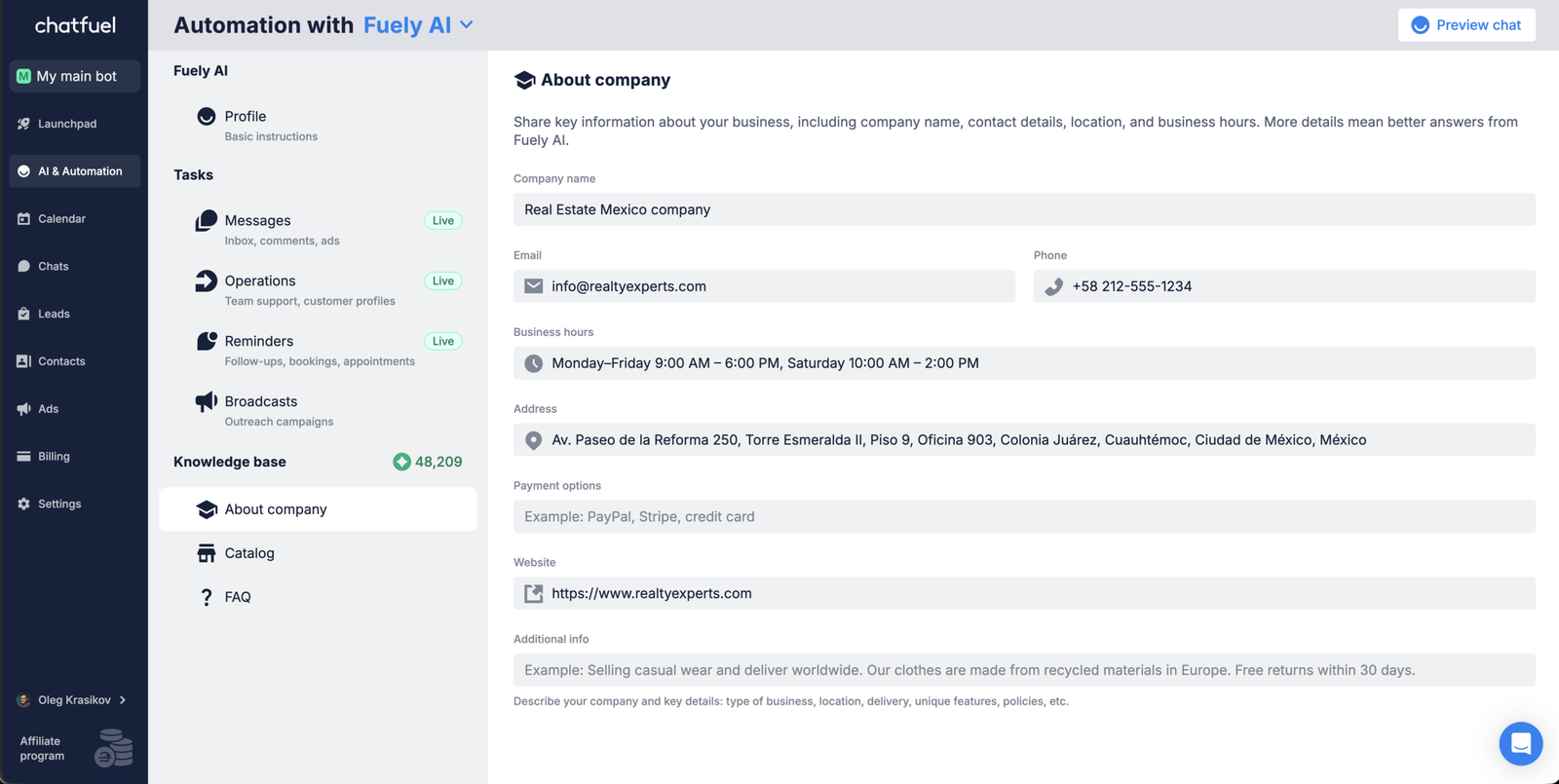
Chatfuel connects to your Facebook page, Instagram account, or WhatsApp Business number and runs conversations automatically. Historically that meant a drag-and-drop flow builder — triggers, conditions, button menus — and that builder is still there and still good. What changed in 2026 is the layer on top: an AI agent that handles free-text messages the buttons never anticipated, answers from a knowledge base you supply, and adapts to your business's tone rather than reciting scripts.
The most commercially interesting piece is lead qualification. Incoming messages get scored and tagged — hot, warm, cold — with hot leads routed to a sales inbox and the rest dropped into nurture sequences. For anyone running paid traffic into WhatsApp or Instagram DMs, that routing is the difference between a full inbox and a full pipeline, and it's the thing Chatfuel now builds its whole marketing around.
Around that sit the practical necessities: a shared team inbox so humans can take over mid-conversation, contact management and segmentation, broadcast and re-engagement campaigns, booking flows, and integrations to Google Sheets, Zapier, Stripe, and the Chatfuel API. If you want a chatbot that lives on your website rather than in Meta's apps, that's a different category — see our Chatbase review for the site-widget approach.
Chatfuel Pricing in 2026 (Verified)
Two plans on the public pricing page, both with usage limits published separately. Annual billing takes 29% off, bringing AI PRO to roughly $34.79/month equivalent, or about $417 for the year.
Chatfuel Light
- Instagram, Facebook & WhatsApp automations
- Shared inbox for conversations
- Automated replies & flow builder
- Contact management & segmentation
- Ready-made templates
AI PRO
- Everything in Light, plus:
- AI sales manager & knowledge base
- AI-powered automations
- Broadcasts & re-engagement
- Lead qualification funnels
Verified August 2026 against chatfuel.com/pricing. Usage limits apply to both tiers and are published on a separate limits page — check them against your expected volume. Agency SAL pricing is not published and requires a sales conversation. Don't forget code TRAKSOURCE for $69 off at checkout.
The Cost Nobody Puts in the Headline: Meta's Message Fees
This is the single most important thing to understand before budgeting for any WhatsApp automation platform, Chatfuel included. Your subscription buys the software. Meta bills you separately for the messages.
Since July 2025, Meta charges per delivered template message rather than per 24-hour conversation. The rate depends on the recipient's country and the message category — marketing messages cost more than utility or authentication ones — and replies you send inside the 24-hour customer service window after a user messages you are free. Rates vary enormously by market: sending marketing messages to Germany costs several times what the same message costs in India, and rates have been adjusted upward in some markets during 2026.
For a business sending a few hundred messages a month, this is noise. For anyone running ads into WhatsApp at volume, it becomes the dominant line item — a campaign pushing 20,000 marketing templates a month can easily cost more in Meta fees than a full year of AI PRO. Meta's WhatsApp pricing has also been in active flux through 2026, so treat any rate card you read — including examples here — as a starting point to verify rather than a fixed number.
- Usage limits are on a separate page. Both tiers carry caps that aren't shown on the main pricing page. Find them and compare against your expected conversation volume before assuming $49 covers you.
- Meta fees are yours, not Chatfuel's. They're billed by Meta according to country and message category, and they scale with outbound volume rather than with your plan.
- Pricing has moved repeatedly in 2026. Published reviews from April, May and June this year each describe a different structure. Verify on the live page — including against this article.
- Meta channels only. WhatsApp, Instagram and Messenger. No Telegram, SMS, or Slack — if your customers aren't in Meta's apps, this is the wrong platform entirely.
- Agency pricing requires a call. If you're evaluating SAL for client work, budget time for a sales conversation; there's no self-serve path or published rate.
Getting Live: The Realistic Sequence
Step 1: Start on Light and connect one channel
Don't pay first. Connect whichever channel already gets you messages — usually Instagram DMs or WhatsApp — and use the free tier's flow builder and shared inbox to see real conversations moving through it.
Step 2: Sort your WhatsApp number properly
As an official BSP, Chatfuel can migrate an existing number without losing history, or warm up a new one over about two weeks. Rushing this is how businesses get restricted, so plan the timeline before you launch ads into it.
Step 3: Automate the top three questions only
Pricing, availability, and booking cover most inbound volume for service businesses. Handle those three well before building anything elaborate — elaborate flows are where projects die.
Step 4: Upgrade when qualification becomes the bottleneck
Move to AI PRO when the volume of free-text questions outgrows your buttons, or when you need lead scoring and broadcasts. That's the honest trigger for $49, not a feature list.
Step 5: Wire hot leads into your CRM
A qualified lead sitting in a chat inbox still isn't a pipeline. Push hot tags into whatever you actually sell from — a CRM like Close — so follow-up isn't a manual read-through.
How Chatfuel Compares
| Feature | Chatfuel | WhatsApp-First Platforms | Website Chatbots |
|---|---|---|---|
| Channels | WhatsApp, Instagram, Messenger | WhatsApp focused | Your website |
| Free Tier | Yes — real automation | Usually trial only | Often limited free |
| Meta Partner Status | Official BSP | Usually BSP | Not applicable |
| Entry Paid Price | $49/mo | Varies, often similar | Frequently lower |
| Meta Fees on Top | Yes | Yes | None |
| Agency Programme | SAL, resell with markup | Varies | Usually affiliate only |
Who Chatfuel Is Best For
- Service businesses taking bookings in DMs. Clinics, salons, fitness coaches, and beauty professionals are Chatfuel's stated core market, and the qualification-plus-booking flow maps neatly onto how those businesses actually sell.
- Anyone running paid traffic into WhatsApp. Ad-to-WhatsApp is a genuinely effective funnel in India, Latin America, and much of Southeast Asia, and automatic hot/warm/cold routing is what stops it drowning your team.
- Instagram-heavy creators and e-commerce brands. Comment-to-DM automation and re-engagement broadcasts are well-trodden ground here. Pair with an email and SMS platform like Omnisend for the channels Chatfuel doesn't touch.
- Agencies building a recurring service line. SAL is explicitly designed to be resold at your own markup with client-owned accounts — a better commercial structure than affiliate commission if messaging automation is a service you deliver.
- Cost-sensitive testers. The free tier means you can validate whether DM automation moves your numbers before committing to anything.
Who Should Skip It
- Businesses whose customers aren't on Meta apps. B2B buyers on email, or audiences on Telegram or SMS, are outside what this platform does.
- Anyone needing deep analytics. Reporting is functional rather than rich; if attribution modelling matters, plan to export data elsewhere.
- Very high-volume senders on tight margins. Not because of Chatfuel's price, but because Meta's per-message fees at scale need modelling carefully whichever platform you choose.
- Teams wanting one tool for everything. Chatfuel is a messaging layer. It won't run your CRM, email, or projects, and doesn't pretend to.
Limitations & Reality Check
- Pricing instability is the real risk. Several distinct structures appeared during 2026 alone. That doesn't make the current $0/$49 wrong, but it means budgeting on today's page carries some uncertainty.
- Usage limits are underexposed. Hiding caps behind a separate limits page is a mild dark pattern; check them before assuming a plan covers your volume.
- Meta dependency cuts both ways. Official partner status brings stability, but policy changes, template rules, and pricing shifts all come from Meta, and no platform insulates you from them.
- Small team, slower roadmap. Roughly $1.6M raised against competitors with a hundred times that. Focused and unlikely to disappear, but not the platform shipping the most new features each quarter.
- The homepage and pricing page describe different products. Until Chatfuel reconciles that, expect confusion — and expect most published reviews to describe whichever version they happened to catch.
- AI qualification still needs supervision. "Adapts to your tone, no flow builder" is a strong claim. Read transcripts weekly for the first month rather than trusting it unattended with paid traffic.
Best Practice: Free First, Fees Modelled Second
Frequently Asked Questions
How much does Chatfuel cost in 2026?
Two published plans: Chatfuel Light is free with no credit card required, and AI PRO is $49 per month, with annual billing taking 29% off — roughly $34.79 per month equivalent, or about $417 a year. Usage limits apply to both and are listed on a separate limits page. Agency SAL pricing isn't published and requires a sales call. TrakSource readers can use code TRAKSOURCE for $69 off at checkout.
Does Chatfuel have a free plan?
Yes. Chatfuel Light is free and includes Instagram, Facebook and WhatsApp automations, a shared inbox, automated replies, the flow builder, contact management and segmentation, and ready-made templates. Several 2026 reviews claim the permanent free tier was removed — that isn't what the current pricing page shows.
Are WhatsApp message costs included in the subscription?
No, and this is the most commonly misunderstood part of WhatsApp automation pricing. Meta charges separately for template messages you send, priced by recipient country and message category, and those charges apply through any provider. Replies you send within the 24-hour customer service window after a customer messages you are free. At high outbound volume, Meta's fees typically exceed the platform subscription.
What is SAL and how is it different from the normal plans?
SAL — System for Automated Leads — is Chatfuel's agency product, pitched as a resellable service rather than a subscription you buy for yourself. It adds native CRM integrations, ready-made funnel templates by niche, agency support, and automated client reporting, and it's sold through a sales conversation with no public pricing. The self-serve Light and AI PRO plans on the pricing page are a separate offering.
Which channels does Chatfuel support?
WhatsApp, Instagram, and Facebook Messenger — Meta's messaging surfaces. There's no Telegram, SMS, email, or Slack support. That focus is deliberate and is why Chatfuel holds official Meta Business Partner and WhatsApp Business Solution Provider status, but it means the platform is the wrong choice if your audience isn't in Meta's apps.
Why does every Chatfuel review quote different prices?
Because the pricing genuinely changed several times during 2026. Articles published this year variously describe monthly-active-user pricing, chat-volume brackets starting around $69, plans named Fuely Super and Fuely Max, and the removal of the free tier. The current structure is Light (free) and AI PRO ($49/month). Verify on the live pricing page before purchasing.
Can I move my existing WhatsApp number to Chatfuel?
Yes. As an official Meta Business Solution Provider, Chatfuel can migrate an existing number while retaining chat history, or warm up a new number over roughly two weeks before you send volume through it. Number warm-up matters — pushing heavy traffic through a cold number is a common cause of restrictions.
Is Chatfuel better than Wati or ManyChat?
They optimise differently. Chatfuel covers all three Meta channels with a free tier and an agency resale programme. WhatsApp-first platforms like Wati go deeper on WhatsApp specifically, including team routing and campaign tooling. ManyChat is far better funded and ships features faster, particularly for Instagram creators. If you want to start free across Meta's channels, Chatfuel has the easiest entry; if WhatsApp is your entire business, a WhatsApp-native platform may fit better.
Final Verdict
Chatfuel is a focused, credible platform for automating conversations where Meta owns the pipes — and after a decade in a category littered with shutdowns, still here and still profitable. The free Light tier is unusually generous for what it includes, $49 for AI-driven qualification is priced fairly, and official BSP status is worth real money the first time you need to migrate a number or get a template approved.
Two caveats decide whether it's right for you. The pricing has been rebuilt repeatedly this year, so verify the live page rather than trusting any review — including this one — and check the separate usage limits against your volume. More importantly, model Meta's per-message fees before you evaluate the subscription, because at any serious scale they'll be the larger number and no platform choice changes that. Start free, prove the funnel converts, then upgrade when qualification becomes your bottleneck — and use code TRAKSOURCE for $69 off when you do.
Try Chatfuel Free — $69 Off With Code TRAKSOURCE →