


Print-on-demand has a dirty secret: the platform you pick matters less than the printer you end up with. The same t-shirt design can come back crisp and colour-true from one facility and washed-out from another — and on most POD platforms, you never find out which facility you got.
Printify built its whole business on flipping that lottery into a choice. It doesn't own a single printer. Instead, it's a marketplace that connects your store to a global network of vetted print providers — and lets you pick which one produces each product, based on price, location, and quality ratings. That model made it the cheapest serious player in POD. But 2026 has been Printify's most eventful year in a decade: a 34% monthly price rise on Premium, and a merger that put it under the same roof as its biggest rival. Here's our fully updated Printify review.
- The marketplace model is the whole story: Printify routes your orders to third-party print providers you choose — which is why its base costs undercut nearly everyone, and why quality depends on your provider pick.
- Pricing changed in February 2026: Premium's monthly price jumped from $29 to $39, while annual billing stayed locked at $299/year (~$24.99/mo). Annual is now the only sensible way to hold Premium.
- Printify and Printful are now the same company: both operate under parent group Fyul since late 2025 — still separate brands, catalogs, and accounts, but the old rivalry now lives under one roof.
- Margins are the reason to be here: base costs on staple products routinely run a few dollars under Printful's — real money at volume — provided you do the sample-ordering homework the network model demands.
Quick Summary
The Marketplace That Made POD Cheap
Printify wins on arithmetic. Because print providers compete for your order inside its network, base costs on core products routinely land a few dollars below in-house rivals — and at a hundred orders a month, "a few dollars" is a few hundred dollars of margin. The trade is that you become the quality-control department: pick providers carefully, order samples, and Printify is the most profitable mainstream POD platform there is. Skip that homework, and the same network becomes a lottery.
Quick Pros & Cons
- Lowest base costs among the mainstream POD platforms.
- 1,300+ product catalog — apparel, home goods, accessories and beyond.
- You choose the print provider per product, per market.
- Genuinely free plan with full catalog access and 5 store connections.
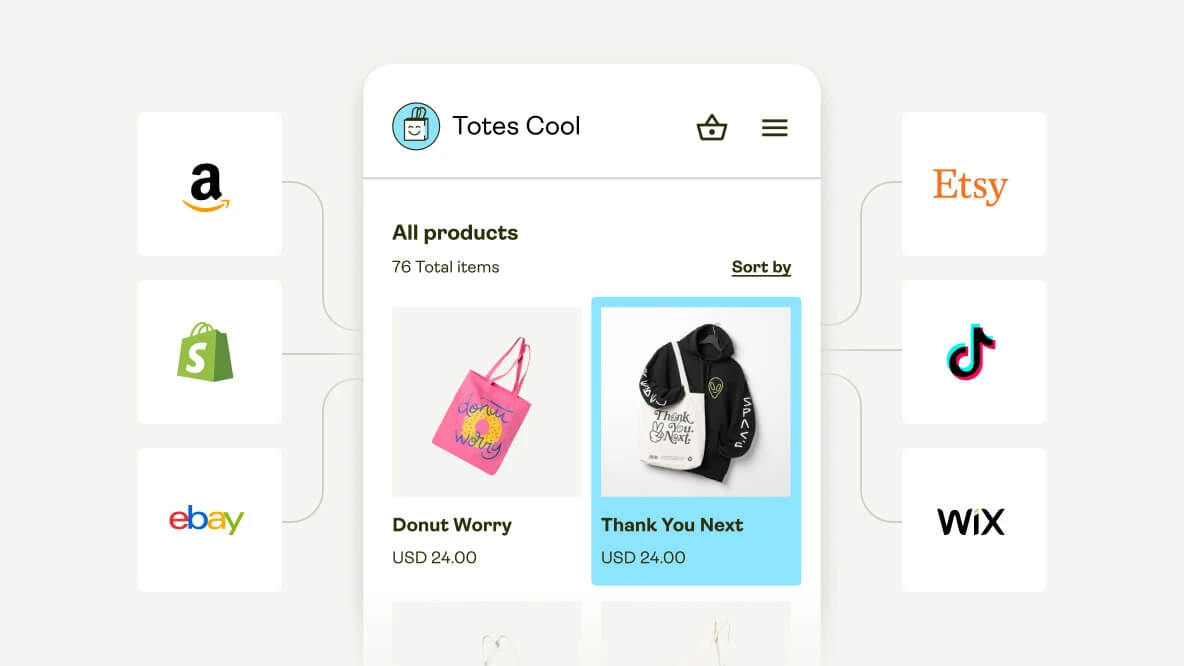
- Deep integration list: Shopify, Etsy, eBay, Amazon, TikTok Shop, WooCommerce, Wix and more.
- Premium's 20% discount is real money at volume.
- Quality varies by provider — consistency is your job, not theirs.
- Premium monthly jumped 34% in Feb 2026 ($29 → $39).
- Shipping rates differ per provider, complicating flat-rate pricing.
- Branding options (neck labels, inserts) depend on the provider.
- No warehousing or custom pack-ins like Printful offers.
- Support sits between you, Printify, and a third-party printer.
What Printify Actually Does
Printify is a print-on-demand marketplace, and that one word explains everything else in this review. It doesn't own factories. When a customer buys from your store, Printify routes the order to one of the independent print providers in its network — the one you selected when you set the product up — and that provider prints, packs, and ships under your store's name. You pay the base cost plus shipping; whatever you charged above that is yours.
This is the exact opposite architecture to its (now sibling) rival Printful, which prints in its own facilities, and to a vertical factory like PODpartner, which knits its own blanks before printing them. The network model trades consistency for competition: providers fight for your order on price, which is why Printify's base costs are the lowest of the big platforms — and why the platform's biggest weakness is that no two providers print identically.
Setting up is free and takes minutes: connect a store, pick a product from the catalog, upload your design in the mockup generator, choose a provider, set your price, publish. From then on, fulfillment is hands-off.
Core Features
The Provider-Choice Mechanic (The Part That Decides Everything)
Open any product in the catalog and you'll see the same design available from multiple print providers — each with its own base cost, shipping rates, production location, average production time, and a community quality rating. The same blank tee can vary by several dollars per unit depending on who prints it. Choosing well is a three-axis decision:
The professional move — and the single best habit a Printify seller can build — is to shortlist two or three providers for your hero product, order a sample from each (samples are available at base cost), and lock in the winner. It costs perhaps $30–40 and one week, and it converts the network's biggest risk into its biggest advantage: you get marketplace pricing with a printer you've personally verified. Sellers on Etsy — still one of Printify's strongest channels, and one worth researching properly with a tool like EverBee — live and die by review scores, which makes this homework non-negotiable.
The Workflow: Design to Doorstep
Step 1: Pick the product & provider
Choose from 1,300+ products, then compare the providers offering it. Filter by print location for your main market, check ratings and production times, and shortlist.
Step 2: Design in the mockup generator
Upload artwork, position it per print area, and generate store-ready mockups. The editor is free, unlimited, and good enough that most sellers never open Photoshop.
Step 3: Sample, then publish
Order a sample at base cost before going live — this is the step that separates profitable stores from refund factories. Then push the product to Shopify, Etsy, or wherever you sell.
Step 4: Auto-fulfillment
Orders route to your chosen provider automatically. They print, pack, and ship under your brand; tracking syncs back to your store. Your job shifts to marketing and margins.
The 2026 Elephant: Printify and Printful Are Now One Company
The biggest change since our last update isn't a feature — it's ownership. Printify and Printful announced their merger in November 2024, and the combined group (together with Snow Commerce) now operates publicly under the parent brand Fyul, pooling a network of over ten million sellers. As of mid-2026, both platforms still run as fully separate brands: separate accounts, separate catalogs, separate pricing, no forced migration. Your Printify store works exactly as before.
So what should a seller actually take from it? Two things. First, the famous "Printify vs Printful" rivalry — the competition that kept both platforms sharp on price — now lives under one roof, which is worth watching as pricing decisions (like February's Premium increase) roll out. Second, the practical comparison still matters, because the two architectures remain genuinely different: Printify's competitive provider network versus Printful's standardized in-house production. We've broken down how that architecture question plays out against a third model entirely — the vertical factory — in our PODpartner vs Printful comparison, and if consolidation makes you want an independent fallback, Gelato's localized production network remains the strongest one.
Printify Pricing in 2026 (Updated for the February Increase)
Three tiers. The headline change: on February 17, 2026, the Premium plan's monthly price rose from $29 to $39 — a 34% jump — while the annual plan stayed locked at $299/year (~$24.99/mo), now bundled with extras like Sellers Club Pro access. The Free plan was untouched. Translation: if Premium makes sense for you at all, it now only makes sense on annual billing.
Free
- Full 1,300+ product catalog
- Unlimited product designs
- Up to 5 connected stores
- All integrations & mockup generator
Premium
- Up to 20% off all products
- Up to 10 connected stores
- Priority support & early feature access
- Sellers Club Pro bundled on annual
Enterprise
- Discounts above Premium rates
- Unlimited connected stores
- Dedicated account manager
- For thousands of orders per day
Verified July 2026. Remember the subscription is only part of the bill: you also pay the per-product base cost and shipping on every order, both of which vary by print provider.
- The monthly Premium price rose 34% in Feb 2026 ($29 → $39). Annual stayed at $299 — if you're keeping Premium, switch billing cycles. Paying monthly now costs $468/year for the identical plan.
- "Up to 20%" means up to. The discount varies by product and provider; model your real savings on your actual bestsellers, not the headline number.
- Shipping is where margins quietly die. Each provider sets its own rates, and a cheap base cost can hide an expensive shipping table. Always compare the landed cost (base + shipping), never base alone.
- Free is genuinely free — full catalog, no card, no trial clock. There is zero reason not to build and sample on the Free plan before paying anyone anything.
The Margin Math That Makes Printify Popular
Here's an illustrative snapshot of why margin-focused sellers default to Printify: the landed cost of a standard printed tee across the three POD architectures. Exact figures move with providers and promotions, so treat these as directional — the gap is the point:
*Different products, different games: the PODpartner figure buys a heavyweight retail-grade blank for premium brands, not a like-for-like comparison — see our PODpartner review for when that trade is worth it. For volume sellers of standard apparel, Printify's number is the one that compounds.
How Printify Compares in 2026
| Feature | Printify | Printful | PODpartner |
|---|---|---|---|
| Production Model | Provider marketplace | In-house facilities | Vertical factory (own blanks) |
| Base Costs | Lowest | Mid | Premium (heavyweight blanks) |
| Quality Consistency | Varies by provider | Standardized | Single-factory consistent |
| Catalog Size | 1,300+ products | 450+ products | Apparel-focused (100+) |
| Branding / Pack-ins | Provider-dependent | Warehousing + inserts | Neck labels, hangtags, poly bags |
| Free Plan | Yes — full catalog | Yes | No fee, pay per piece |
| Paid Tier | $299/yr or $39/mo | Growth $24.99/mo (free past $12K/yr) | None |
| Ownership | Fyul group | Fyul group | Independent |
Who Printify Is Best For
- Margin-first volume sellers: If you move 50+ units a month of standard products, the base-cost gap plus the Premium discount is the biggest profit lever in mainstream POD.
- Etsy and marketplace sellers: The Etsy integration is mature, and the low base costs leave room for Etsy's fees without destroying your margin.
- Multi-market stores: Provider choice means you can route US orders to a US printer and EU orders to an EU one — faster delivery, lower shipping, happier reviews.
- Product testers: Free plan, unlimited designs, 1,300+ products — the cheapest possible sandbox for validating niches before committing anywhere.
- Multi-store operators: 5 stores free, 10 on Premium, and email flows across all of them are a solved problem with a tool like Omnisend.
Who Should Skip It
- Premium apparel brands: If your product needs 400GSM+ blanks, custom washes, and embroidery layered over print, no provider network stocks that — that's vertical-factory territory.
- Zero-homework sellers: If you refuse to order samples, Printful's standardized output will punish you less than an unvetted network provider will.
- Unboxing-experience brands: No warehousing, no custom pack-ins, and branding that depends on which provider you picked.
- Anyone allergic to three-party support: When an order goes wrong, resolution runs through Printify and the provider. It usually works; it's rarely fast.
Limitations & Reality Check
- The quality lottery is real if you don't sample. The network's price competition is also its variance. Provider ratings help; a $15 sample order settles it. There is no shortcut here.
- Shipping tables vary per provider. Flat-rate shipping across a multi-provider store takes spreadsheet work, and a provider switch can silently change your landed costs.
- The Feb 2026 price rise stung monthly subscribers. A 34% increase with the annual rate untouched is a clear nudge toward annual commitment — fine if you're established, annoying if you're seasonal.
- Branding is provider-dependent. Some providers offer neck labels and gift messages; many don't. If unboxing is part of your brand, audit your specific provider before scaling.
- Fyul concentration risk. Printify and Printful under one owner means the industry's two default choices are no longer independent hedges against each other. Keeping design assets portable and one outside alternative tested is now basic hygiene.
- Discounts are "up to" 20%. Your real Premium saving depends on your product mix — run the calculator above with honest numbers before subscribing.
Best Practice: The Provider Lock-In Play
The sellers who make Printify look brilliant and the ones who rage-quit it are running the same platform. The difference is a one-week routine at the start.
Frequently Asked Questions
How much does Printify cost in 2026?
The Free plan is $0 forever with full catalog access and up to 5 connected stores. Premium costs $299/year (~$24.99/month) on annual billing, or $39/month on monthly billing after the February 17, 2026 price increase (it was previously $29/month). Enterprise is custom-priced for merchants doing thousands of orders daily. On every plan you also pay per-order base costs and shipping, which vary by print provider.
Is Printify really free?
Yes. The Free plan has no card requirement, no trial clock, unlimited designs, the full 1,300+ product catalog, all integrations, and up to 5 store connections. You only ever pay when a product is actually ordered — either by a customer or by you as a sample.
Is Printify Premium worth it after the price increase?
On annual billing, usually yes once you're past roughly 15–30 orders a month (depending on your product mix) — the up-to-20% product discount outruns the ~$25/month fee quickly at volume. On monthly billing at $39, the break-even point is meaningfully higher, which is why annual is now the only billing cycle we'd recommend for Premium.
Did Printify and Printful really merge?
Yes. The merger was announced in November 2024, and the combined group — including Snow Commerce — now operates under the parent brand Fyul, announced publicly in late 2025. As of mid-2026 both platforms still run separately with their own accounts, catalogs, and pricing, and no seller migration has been forced.
Is Printify's print quality good?
It can be excellent — but it depends on the provider you choose, because Printify doesn't print anything itself. Providers vary in equipment, inks, and consistency. The reliable fix is ordering samples from two or three shortlisted providers, wash-testing, and locking in the best one before scaling. Sellers who do this report quality on par with any in-house platform.
Which platforms does Printify integrate with?
Shopify, Etsy, eBay, Amazon, TikTok Shop, Walmart, WooCommerce, Wix, Squarespace, BigCommerce, PrestaShop, and a public API. There's also the free Printify Pop-Up Store if you want to sell without running your own website.
How does shipping work on Printify?
Each print provider sets its own shipping rates and production times, so shipping cost depends on which provider you picked and where the customer lives. The practical play is choosing providers located in your main sales regions, and always comparing landed cost — base price plus shipping — rather than base price alone.
What's the difference between Printify and Printful now?
Architecture. Printify is a marketplace routing orders to third-party providers you choose — cheapest base costs, variable consistency. Printful prints in its own facilities — higher base costs, standardized output, plus warehousing and branded pack-ins. Since late 2025 both belong to the same parent company, Fyul, but operate as separate products with separate pricing.
Final Verdict
Printify's pitch hasn't changed in a decade, and 2026 hasn't dented it: it is still the cheapest serious way to run a print-on-demand business, and the provider-choice mechanic — used properly — turns its one structural weakness into an advantage no in-house platform can copy.
What has changed is the fine print. The February price rise makes annual billing the only rational way to hold Premium, and the Fyul merger means the platform's historic rival is now its sibling — an argument for keeping your designs portable and one independent alternative sampled, even while Printify remains your workhorse. Do the sample-order homework once per product, run the break-even math honestly, and Printify remains what it's been for years: the margin king of print-on-demand.
Start Selling on Printify — Free →