
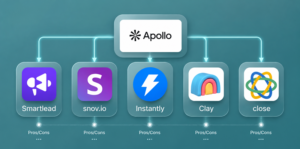

Apollo.io sells four products under one subscription: a B2B contact database, an email sequencer, a dialer, and a light CRM. It charges per seat for the whole bundle, whether your team uses all four or one. That's the entire reason people start looking for alternatives — not because Apollo is bad at what it does, but because a five-person team pays five times for capabilities that three of those people never open.
The alternatives below win by unbundling. Each one takes a slice of what Apollo does and prices it flat instead of per head. That's a real saving, and the arithmetic below is not subtle. But unbundling has a cost that most "best Apollo alternatives" articles skip entirely, so let's put it up front: nothing on this list replaces all four pieces, and the piece hardest to replace is the database — we put Apollo's contact data up against a dedicated email finder in our Hunter.io vs Apollo.io comparison, and the coverage gaps run in both directions. If you leave Apollo without knowing which slice you actually depend on, you'll save money and break your pipeline in the same month.
- Per-seat is the problem, not the price. Apollo's Professional tier is $99/user/month ($79 annual). Instantly, Smartlead and Snov.io charge the same flat fee whether you have two users or twenty.
- Export credits are the real currency. Apollo's "unlimited email credits" headline hides the metered number that actually constrains you — 1,000 to 4,000 export credits per user per month, which don't roll over.
- The database is the hard part to replace. Instantly sells one as a separate subscription; Smartlead has none; Snov.io's credits are far smaller than Apollo's. Budget for this or you haven't actually saved anything.
- Only leave for a named reason. "Too expensive per seat," "I only use the sequencer," or "I need agency workspaces" are good reasons. "Apollo's data is bad" usually means your ICP filter is bad.
Checked directly: every price in this article was read off each vendor's own pricing page in September 2026. Apollo's tiers were additionally cross-checked against three independent sources, which agree on all three paid tiers.
Conflicts are disclosed, not smoothed over. Clay's published pricing does not reconcile across sources — including its own page — and that's stated in its section rather than resolved by picking a number. Instantly's own two sources disagree on one allowance, and that's flagged too.
Source caution: most "Apollo alternatives" articles ranking today are published on the blogs of companies selling one of the alternatives. Several were excluded from the price checks for that reason. This article has the same conflict of interest — see the disclosure below — which is why the per-seat arithmetic is shown rather than asserted, so you can redo it with your own headcount.
Not claimed: no head-to-head data-accuracy test was run across these databases. Bounce-rate figures quoted in competing articles almost never come with a published seed list or sample size.
The Top Apollo Alternatives Compared





The Core Problem with Apollo
Apollo's current lineup is Free, Basic at $59/user/month ($49 annual), Professional at $99/user/month ($79 annual), and Organization at $149/user/month ($119 annual, minimum three users). Those figures are consistent across Apollo's own materials and three independent sources.
The price per seat isn't unreasonable for what's included. The problem is the multiplier. Outbound teams are seat-heavy by nature — SDRs, a manager, an ops person, a founder who logs in twice a month — and Apollo charges full freight for every one of them. Add two SDRs and your bill rises by $198 a month whether or not they generate a single reply.
On the face of it that's roughly $398 a month — near enough $4,800 a year — for a five-person team moving from Apollo Professional to Instantly. Which brings us straight to the thing that makes that number less impressive than it looks.
- If you already buy lead data elsewhere — ZoomInfo, Clay, a list vendor, LinkedIn Sales Navigator plus a verifier — the $4,800 is real, because you're paying Apollo for a database you don't use.
- If Apollo is your database, add the replacement cost before you celebrate. Depending on volume that can eat half the saving or all of it.
- If your team is one or two people, the per-seat argument mostly evaporates. Apollo Basic for two seats is $118/month, which is in the same bracket as every flat plan here.
The second problem: export credits
Apollo advertises "unlimited email credits," which sounds generous and isn't the constraint. The metered number that actually governs your month is export credits — roughly 1,000 per user per month on Basic, 2,000 on Professional, and 4,000 on Organization. One credit is consumed each time you push a contact to CSV or sync it to your CRM.
They don't roll over. In practice this produces a familiar pattern: heavy exporting in week one, rationing by week three, and a manager discovering in week four that the team stopped prospecting because the credits ran dry. If that describes your month, the fix isn't necessarily a different platform — it may be a tighter ICP filter, since the credits are usually burned on bulk-exporting lists nobody ever emails. A cheaper diagnostic is to run one month's prospecting through a dedicated finder like Hunter.io and compare the volume you actually email against what you were exporting.
1 Instantly
Instantly is the cleanest structural answer to the per-seat problem. It charges for sending capacity — monthly email volume and stored contacts — and nothing else. Mailboxes are unlimited on every paid tier, warmup is unlimited and included, and adding team members doesn't change the bill at all. For a team whose Apollo cost is driven by headcount rather than usage, that single design decision is the whole argument.
Plans run Growth at $47/month ($37.60 annual, 5,000 emails and 1,000 contacts), Hypergrowth at $97 ($77.60 annual, 25,000 contacts), and Light Speed at $358 ($286.30 annual, 100,000 contacts). Growth is a testing tier — 5,000 emails is roughly four days of real sending for one rep — so Hypergrowth is the honest entry point for anyone replacing Apollo.
Two caveats worth knowing before you migrate. Instantly's lead database is a separate subscription, so it doesn't inherit Apollo's data by default. And Instantly's own pricing page and help centre have published conflicting figures for the Hypergrowth email allowance — 100,000 against 125,000. Plan against the lower number and get it confirmed in writing before an annual commitment. If personalisation matters more to you than raw volume, Lemlist is the usual counter-pick at this tier, though it reintroduces per-seat billing.
- No per-seat fee at all — add the whole team for free.
- Unlimited mailboxes and unlimited warmup on every paid tier.
- Cleanest interface of any tool on this list.
- Unified reply inbox across every connected mailbox.
- Lead database costs extra — it does not replace Apollo's data.
- $261 gap between Hypergrowth ($97) and Light Speed ($358).
- Its own pages disagree on the Hypergrowth email limit.
- Domains and mailboxes are bought elsewhere, on your budget.
2 Snov.io
If Instantly is the cleanest structural answer, Snov.io is the closest like-for-like swap. It's the only tool on this list that does what Apollo does end to end under one subscription: find the contact, verify the email, run the sequence, and track the deal in a built-in CRM. For a team that genuinely uses several of Apollo's four products, it's the migration with the fewest holes to plug.
Pricing is flat with unlimited seats. Starter is $39/month ($29.25 annual) for 1,000 credits and 5,000 recipients; Pro S at $99/month ($74.25 annual) is the tier most teams land on, covering 5,000 credits and 25,000 unique recipients — that recipient allowance was raised from 10,000 at the same price in May 2026, which is an unusually good direction for a pricing change to move. Pro M and Pro L run $189 and $369 for larger volumes.
The honest caveat is LinkedIn. Snov.io's multichannel story is real, but automated LinkedIn touches cost $69/month per account slot ($62 annual) on top of the base plan. A three-rep team wanting LinkedIn automation is looking at $99 plus $207, which changes the arithmetic considerably. Email-only, the flat pricing holds.
- Genuinely all-in-one: finder, verifier, sender and CRM.
- Flat pricing with unlimited seats — $99 covers the whole team.
- Pro S recipient cap rose 2.5× in 2026 at the same price.
- 25% saving on annual billing, one of the steepest here.
- LinkedIn automation is $69/mo per slot, not included.
- Credit allowance is well below Apollo's export ceiling.
- A/B testing and spintax require a Pro tier.
- Database breadth doesn't match Apollo's at the top end.
3 Smartlead
Smartlead exists for a specific situation Apollo handles badly: sending on behalf of other people. If you run cold email for clients, Apollo's per-seat model compounds twice — once for your team, and again every time a client needs visibility. Smartlead solves it at the architecture level rather than the pricing level.
Each client workspace is genuinely isolated: its own billing view, reply queue, API token and connected mailboxes. You can hand a client a white-labelled portal on your own domain where they log in, see their campaigns and read their replies without seeing your other clients or your margins. That runs roughly $29 per client per month, with one portal included free on Pro and above.
Plans are Basic at $39/month (2,000 leads, 6,000 emails), Pro at $94 (30,000 leads, 150,000 emails), and Unlimited Smart at $174 with no volume ceiling at all. Like Instantly, there are no per-seat fees and mailboxes are unlimited. Unlike Instantly, there's no lead database whatsoever — Smartlead assumes you bring your own data, which makes it a poor fit if Apollo's database is what you're trying to replace.
- Genuinely isolated client workspaces with separate billing.
- White-label client portals on your own domain.
- Published unlimited plan at $174 — no enterprise call.
- No per-seat fees; unlimited mailboxes and warmup.
- No lead database at all — bring your own data.
- White-label portals add ~$29 per client per month.
- Denser interface with a longer learning curve.
- Much smaller review base to research before buying.
4 Close
A significant number of Apollo users aren't really using it for prospecting at all. They're using it as a cheap CRM with a dialer attached, and tolerating a database they barely touch. If that's you, the right move isn't another sequencer — it's an actual CRM.
Close is built around the phone in a way Apollo isn't. The 2026 lineup is Solo at $9/user/month (annual), Essentials at $35, Growth at $99, and Scale at $139, with monthly billing at $19/$49/$109/$149. The Power Dialer — the feature most people actually come for — starts at Growth, and the multi-line Predictive Dialer plus call coaching require Scale.
Be clear-eyed about what this does and doesn't fix: Close is per-seat too. Five people on Growth is $495/month, identical to Apollo Professional. It doesn't solve the per-seat problem at all. What it solves is the "we're paying for four products and only want the CRM one" problem — you get a much better CRM and dialer for the same money, and drop the database you weren't using.
- A real CRM with a genuinely good built-in phone.
- Solo at $9/user is among the cheapest real CRMs available.
- Power Dialer and call coaching built in, not bolted on.
- Up to 35% saving on annual billing.
- Per-seat pricing — does not fix Apollo's core cost problem.
- No B2B contact database of its own.
- The headline features start at the $99 Growth tier.
- Call and SMS usage is billed on top of seat costs.
5 Clay
Clay is on this list for a different reason from the others, and it's worth saying plainly: TrakSource has no affiliate relationship with Clay and earns nothing if you sign up. It's here because leaving Apollo often means confronting the data question, and Clay is the most credible answer to it.
Rather than being a database, Clay is an orchestration layer that runs waterfall enrichment — it queries multiple data providers in sequence until one returns a verified result, then stops. That architecturally beats any single database on coverage, because no single provider wins across every geography and seniority band. It's also where Apollo's "the data is bad" complaint usually gets resolved: the problem was rarely Apollo's accuracy in isolation, it was depending on one source.
- Waterfall enrichment beats any single database on coverage.
- Unlimited seats on every tier, including the free plan.
- Free plan is genuinely usable for evaluating fit.
- The right layer to sit above a cheap flat-rate sender.
- Published pricing is genuinely unclear across sources.
- Credit overages reportedly carry a top-up surcharge.
- Steep learning curve — closer to a spreadsheet than a tool.
- Not a sequencer; you still need something to send with.
At a Glance: What Each One Actually Replaces
Apollo bundles four products. This table is the fastest way to see which slice each alternative takes, and where the holes are.
| Platform | Pricing Model | Lead Database | Sequencer | Working Tier |
|---|---|---|---|---|
| Apollo | Per seat | Included | Included | $99/user/mo |
| Instantly | Flat — unlimited seats | Separate subscription | Core product | $97/mo total |
| Snov.io | Flat — unlimited seats | Included, credit-metered | Included | $99/mo total |
| Smartlead | Flat — unlimited seats | None | Core product | $94/mo total |
| Close | Per seat | None | Included | $99/user/mo |
| Clay | Flat — unlimited seats | Waterfall enrichment | None | Volume-dependent |
"Working tier" is the plan a real team actually lands on, not the advertised entry price. Apollo and Close figures are monthly billing; both discount annually.
How to Leave Apollo Without Breaking Your Pipeline
The failure mode in every migration is the same: cancel first, discover the gap second. This sequence avoids it, and none of it requires running two full subscriptions for longer than a month.
Step 1: Audit which of the four you actually use
Open your Apollo account and check, per user, how many export credits were consumed last month and how many sequences are live. If exports are near zero, you're paying for a database you don't use and the saving is real. If they're maxed out, replacing Apollo means replacing data first.
Step 2: Export everything while you still have credits
Contacts, sequences, templates and reply history. Do this before you cancel, not after — and be aware exports consume the same credits you're trying to preserve, so budget the final month's allowance for it.
Step 3: Solve data before you solve sending
Decide where leads will come from — Clay, a list vendor, Sales Navigator plus a verifier, or Snov.io's built-in credits. Sending platforms are interchangeable and easy to switch later. A data source you haven't chosen is the thing that actually stalls a migration.
Step 4: Run both in parallel for 30 days
Keep Apollo live on a reduced seat count while the new stack runs the same campaign on fresh domains. One month of overlap costs far less than a quarter of broken pipeline, and it's the only way to know the replacement works on your list.
Step 5: Cancel at the renewal boundary, not mid-term
Annual Apollo commitments don't refund on cancellation, so time the switch to the renewal date. If you're mid-term, run the parallel period anyway and let the new stack mature — the overlap is nearly free when the old subscription is sunk cost.
The Alpha Play: Unbundle Deliberately
Frequently Asked Questions
How much does Apollo.io actually cost in 2026?
Apollo runs a free tier plus three paid plans, priced per user per month: Basic at $59 monthly ($49 annual), Professional at $99 monthly ($79 annual), and Organization at $149 monthly ($119 annual) with a three-user minimum. Because pricing is per seat, headcount drives the bill — a five-person team on Professional pays $495 a month on monthly billing, or $395 on annual.
What is the cheapest Apollo alternative for a team?
For teams, the cheapest options are the ones that don't charge per seat. Smartlead Pro at $94/month, Instantly Hypergrowth at $97/month and Snov.io Pro S at $99/month each cover your entire team for one flat fee. The catch is that only Snov.io includes a lead database at that price — with Instantly it's a separate subscription and with Smartlead there isn't one, so factor in data costs before comparing to Apollo's number.
Do any of these alternatives replace Apollo's B2B database?
Not fully. Snov.io comes closest with built-in finding and verification, but its credit allowances are smaller than Apollo's export ceiling. Instantly sells a lead database as a separate subscription. Smartlead and Close have none at all. Clay takes a different approach entirely, running waterfall enrichment across multiple providers rather than owning a database — which generally beats any single source on coverage but requires more setup.
What are Apollo export credits and why do they run out?
Export credits are consumed each time you push a contact to CSV or sync it to your CRM — roughly 1,000 per user per month on Basic, 2,000 on Professional and 4,000 on Organization. They don't roll over. Apollo's "unlimited email credits" headline refers to a different pool and isn't the constraint most teams hit. If you're running out mid-month, the cause is usually bulk-exporting lists that never get emailed rather than the allowance being genuinely too small.
Is Apollo's data accuracy actually worse than alternatives?
There's no credible published head-to-head test across these databases, and bounce-rate figures quoted in competing articles almost never come with a seed list or sample size. What's true structurally is that any single-source database has coverage gaps that vary by geography and seniority, which is why multi-provider waterfall enrichment tends to outperform it. If your Apollo bounce rate is high, check your ICP filters and run a verifier before concluding the database is the problem.
Which Apollo alternative is best for an agency?
Smartlead, by a clear margin. Its client workspaces are genuinely isolated — separate billing views, reply queues and API tokens — and it sells white-label portals on your own domain at roughly $29 per client, with one included on Pro and above. Apollo's per-seat model compounds badly in an agency because every client stakeholder who needs visibility is another seat.
Should I switch if I'm a solo founder?
Probably not for cost reasons. The per-seat argument is the main case against Apollo, and at one or two seats it mostly disappears — Apollo Basic for two users is $118/month, which sits in the same bracket as every flat plan on this list while including a database they mostly don't. Switch if you need something Apollo does badly, such as high-volume sending across many mailboxes, not to save $20.
Can I use two of these tools together?
Yes, and it's usually the better architecture. The common pairing is a data layer plus a flat-rate sender — Clay or a list vendor for enrichment, then Instantly, Smartlead or Snov.io for sending. Two specialised flat subscriptions typically cost less than one per-seat bundle for a team of four or more, and each half can be swapped without disturbing the other.
Final Verdict
Apollo isn't a bad product, and most people who leave it aren't leaving because of quality. They're leaving because they're buying four things and using one or two, at a price that scales with headcount rather than usage. That's a structural mismatch, not a failure, and it means the right alternative depends entirely on which slice you were actually using.
If your Apollo bill is driven by seats and you already source data elsewhere, Instantly is the cleanest escape — flat pricing, unlimited mailboxes, and nothing charged per head. If you genuinely use the whole bundle and want the fewest holes to plug, Snov.io is the closest like-for-like swap at $99 flat for the team. Agencies should go straight to Smartlead for the client workspaces. Teams who were really just using Apollo as a CRM should look at Close, understanding it won't fix per-seat costs. And whichever sender you pick, solve the data question with something like Clay before you cancel anything.
The one thing worth resisting is swapping one bundle for another and calling it a saving. Run the thirty-day parallel test, count replies rather than opens, and let your own numbers decide.