

Developers are using tools like Cursor and Claude to generate hundreds of lines of code in minutes. The problem? Human QA engineers cannot possibly review and test code at that speed.
We have entered the era of "Vibecoding," where you prompt an app into existence and hope it doesn't break in production. TestSprite was built to solve this exact bottleneck. It is a fully autonomous AI testing platform that writes test plans, generates scripts, executes them in the cloud, and suggests fixes directly into your IDE. In this TestSprite review, we put its end-to-end testing engine to work on a live project.
Quick Summary
The "Vibecoding" Safety Net
If you use Cursor or Copilot to write code, you need AI to test that code. TestSprite is essentially an autonomous QA engineer. It deploys ephemeral cloud sandboxes to rigorously validate UI flows and APIs, catching hallucinations and logic errors before your users do. It eliminates the manual drudgery of writing unit and integration tests.
Start Testing For Free (150 Credits) →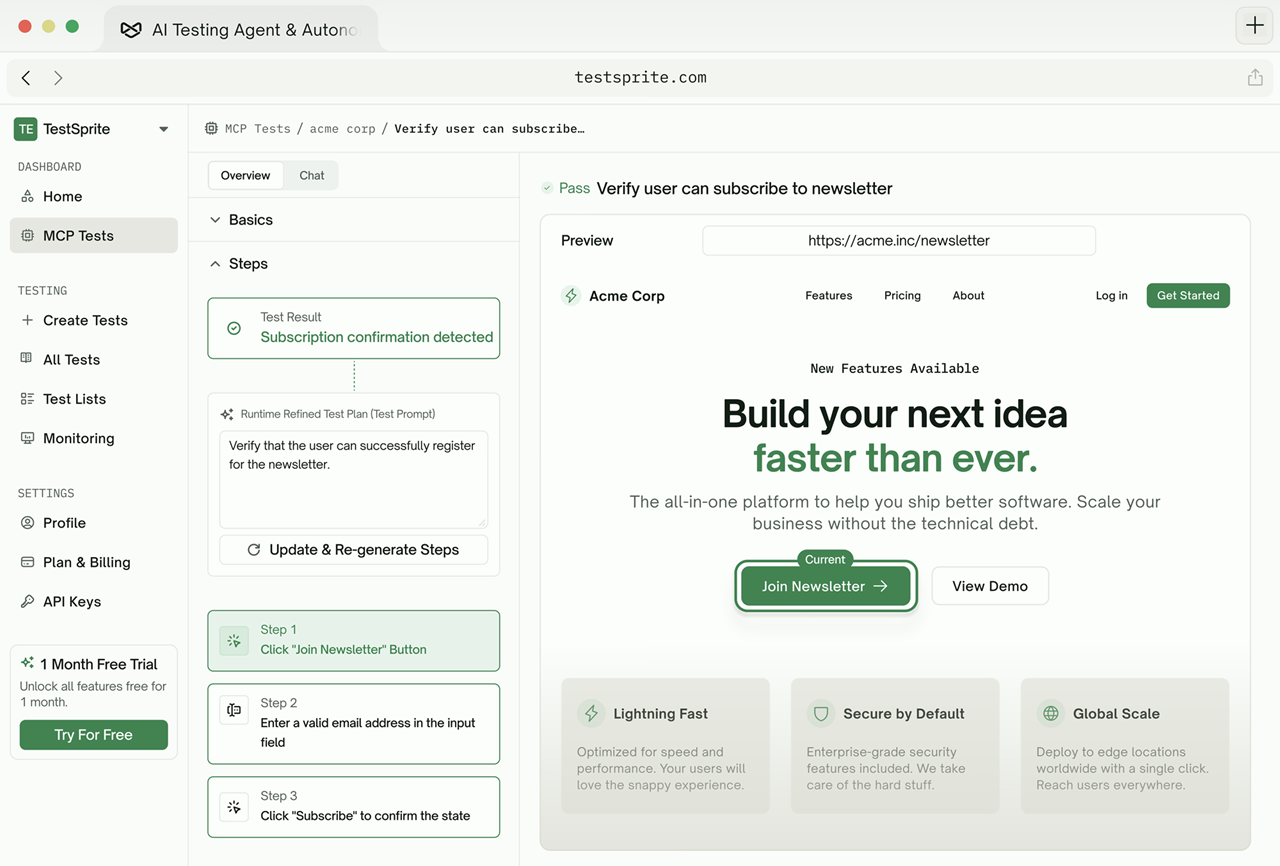
What TestSprite Actually Does
Traditional testing requires setting up heavy frameworks (like Selenium or Cypress) and writing brittle scripts that break whenever a button moves.
TestSprite flips this model. You provide your app URL, API documentation, or a Product Requirements Document (PRD). The AI agent crawls the application, understands its intent, and automatically generates comprehensive test cases. It then runs those tests in its own secure cloud environment. If a test fails, it provides a detailed trace and actively suggests the exact code fix required.
Core Features
How to Use TestSprite — Workflow
We connected TestSprite to a local Node.js/React project using the MCP (Model Context Protocol) server inside Cursor.
- The Setup: We installed the TestSprite MCP server via npm and entered our API key into Cursor.
- The Prompt: We dragged our project files into the chat and typed: "Help me test the user authentication flow."
- The Execution: TestSprite automatically analyzed the code, generated 12 backend API tests and 5 frontend UI tests, and executed them in the cloud.
- The Result: It flagged a broken edge case in our password reset logic, returned the error trace, and provided the exact code snippet needed to fix it directly in the IDE.
Example Use Cases
Who TestSprite Is Best For
- Cursor & Claude Users: If you use AI to code, the native MCP server integration is an absolute game-changer.
- Agile Development Teams: Teams that deploy fast and need reliable CI/CD quality gates without writing manual Playwright scripts.
- Non-Technical Founders: The ability to write test requirements in plain English democratizes QA.
Who Should Avoid TestSprite
- Strict Enterprise Intranets: Because tests run in TestSprite's cloud, testing highly secured internal apps requires complex tunneling setup.
- Low-Budget Hobbyists: Generating comprehensive tests consumes credits quickly. It can get expensive if you run massive test suites multiple times a day.
Pricing & The Credit System
TestSprite operates on a credit-based model. Because AI test execution is computationally heavy, you pay based on usage.
| Plan | Price (Monthly) | Limits & Features |
|---|---|---|
| Free | $0 | 150 credits / Foundational models / Basic testing |
| Starter | $19 /mo | 400 credits / Advanced AI models / Priority support |
| Standard | $69 /mo | 1600 credits / Custom configurations / Optimized execution |
How TestSprite Compares
| Feature | TestSprite | Testim | Playwright (Manual) |
|---|---|---|---|
| Test Creation | Autonomous AI | Low-Code Record | Manual Coding |
| IDE Integration | Deep (MCP Server) | Limited | High (Native) |
| Self-Healing | Yes + Fix Suggestions | Yes (Locators only) | No |
| Setup Time | Minutes | Hours | Days |
Limitations & Reality Check
- False Positives: It is an early-stage AI tool. It occasionally misunderstands highly complex, domain-specific business logic, leading to tests that fail incorrectly. You still need to review the AI's test plan.
- Cloud Dependency: Tests execute on their servers. If your application is heavily firewalled or relies on sensitive local databases without a tunnel, execution will fail.
Best Practices: "The PRD Anchor"
The AI is only as smart as your instructions.
Pros & Cons
- MCP Server integration allows testing directly inside Cursor/VSCode.
- Eliminates the need to maintain brittle UI automation frameworks.
- Provides comprehensive coverage across both API and Frontend layers.
- Generous free tier (150 credits) to test the platform risk-free.
- Credit-based pricing can scale up quickly for large CI/CD pipelines.
- Requires tunneling software to test purely local, non-public apps.
- AI can occasionally generate redundant or false-positive tests.
Frequently Asked Questions
What is an MCP Server?
MCP (Model Context Protocol) allows AI IDEs like Cursor to communicate securely with external tools. TestSprite uses MCP to analyze your local code, run tests, and push fix recommendations directly into your editor.
Can it test APIs?
Yes. TestSprite excels at backend API testing, verifying response content, edge cases, and boundary limits automatically.
Do I have to write test scripts?
No. The core value of TestSprite is that it generates the test plans and the underlying execution code entirely based on your app's UI or provided documentation.
Is my code secure?
TestSprite runs executions in ephemeral cloud sandboxes. However, as with any AI tool, you are sharing application context with their servers. They offer enterprise plans for stricter compliance needs.
Final Verdict
"AI tests AI" is the only logical conclusion to the current software development boom. If AI can write 1,000 lines of code in seconds, human QA cannot keep up.
TestSprite is bridging that gap. While it is still evolving and requires a watchful eye to filter out false positives, its deep integration with modern IDEs via MCP makes it an indispensable tool for fast-moving developers. It drastically lowers the barrier to achieving production-grade test coverage.
Automate Your QA (Start Free) →