


If you are attempting to beat the market using consumer-grade screeners or basic ChatGPT prompts, you are trading at a severe disadvantage. Retail investors rely on lagging indicators and emotional narratives. Institutional funds rely on quantitative factor modeling, machine learning, and alternative data like Congressional stock trades.
Kavout was built to bridge this data gap. It operates as a quantitative AI research engine, analyzing millions of data points across global markets to generate its proprietary "K Score" and surface high-probability trading signals. But does it actually provide a Bloomberg Terminal-level edge at a retail price point? In this Kavout technical audit, we stress-test their InvestGPT workflows and factor models to find out.
1. Quick Summary
2. The TL;DR Verdict
Institutional Intelligence at Retail Pricing
Kavout removes the emotional bias from fundamental analysis. By utilizing machine learning to blend proven investment strategies (like Piotroski and Greenblatt) with real-time alternative data (insider buys, Congressional trading), it distills complex market noise into actionable, quantitative scores. It is the ultimate time-saving infrastructure for serious market operators.
Access the AI Quantitative Engine →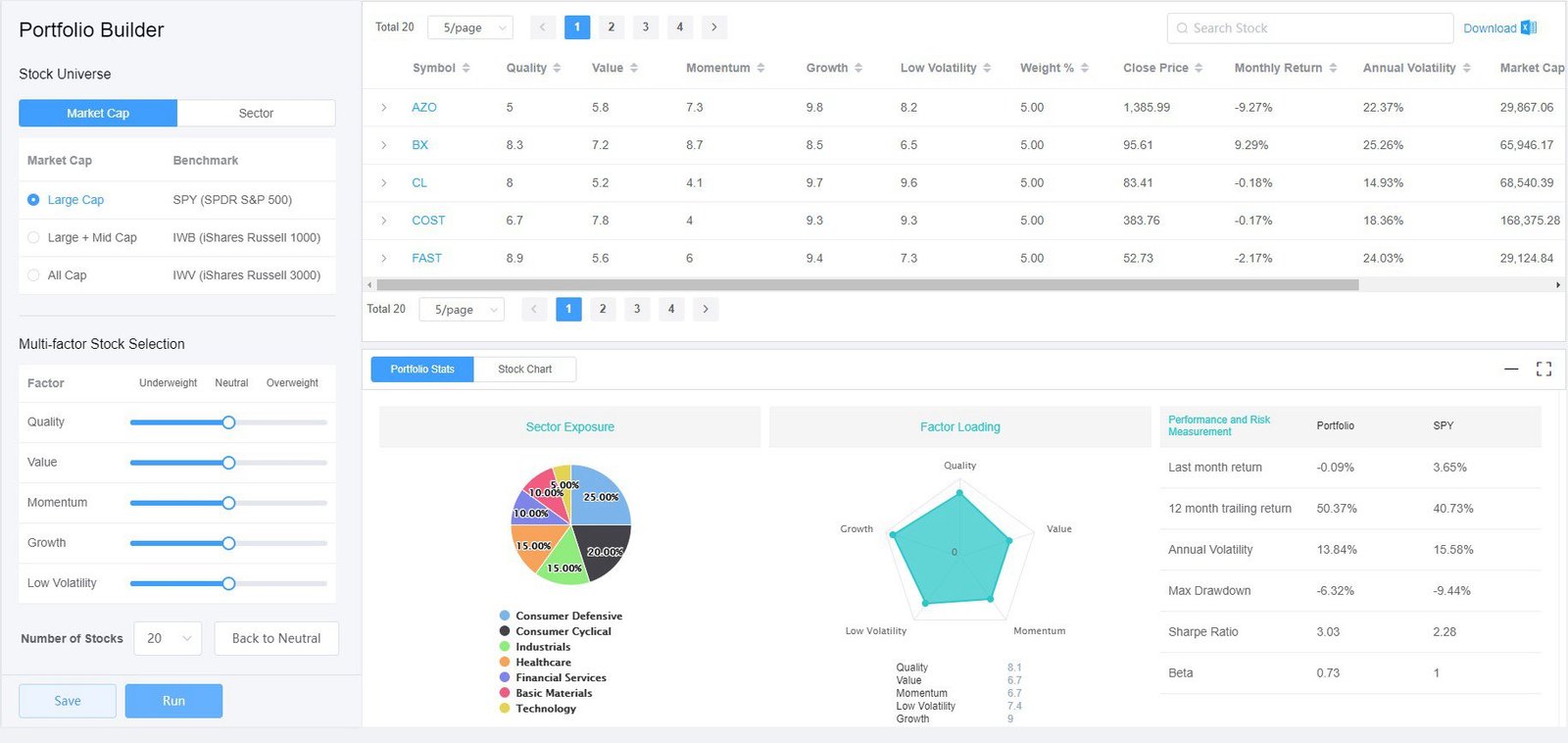
3. What Kavout Actually Does
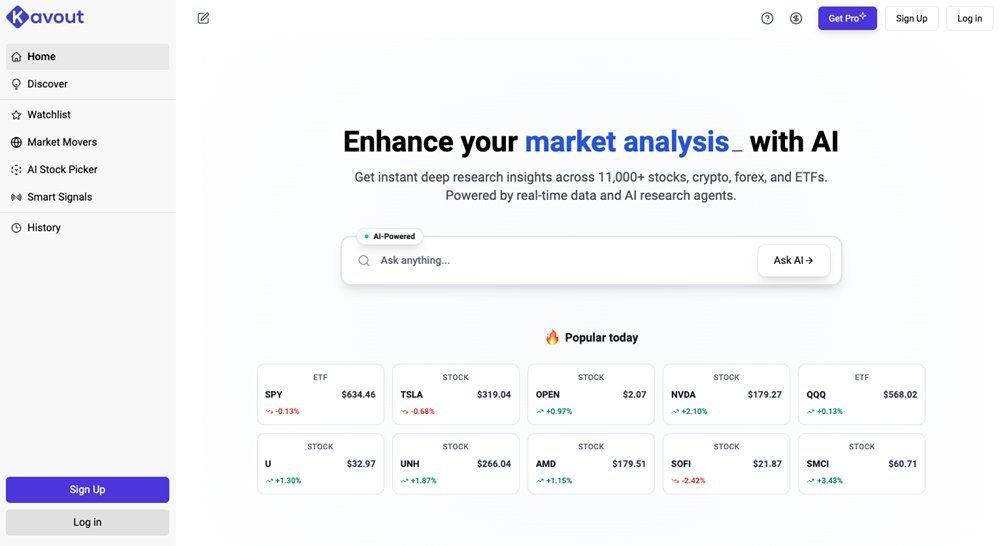
Kavout is not just an LLM wrapper. It is a proprietary quantitative engine powered by massive streams of real-time financial data.
When you query InvestGPT (their custom AI assistant), it doesn't just guess based on outdated internet text. It pulls real-time financial metrics, parses current news sentiment, and analyzes factor data (Value, Quality, Momentum) across 30+ global markets. The core of the platform is the K Score—an AI-generated rating (from 1 to 9) that predicts a stock's probability of outperforming the market over the next month, allowing traders to build data-backed watchlists instantly.
4. Core Features
5. The Data: The Speed of Due Diligence
Running comprehensive fundamental and technical analysis on a single stock manually can take hours. Here is the operational shift when utilizing Kavout's AI agents.
6. The Technical Setup (Factor Models)
The foundation of Kavout’s K Score isn't speculative AI generation; it is deeply rooted in traditional quantitative finance.
The AI continuously evaluates stocks based on established factor models—Quality, Value, Growth, and Momentum. It integrates legendary screening logic (like Joel Greenblatt’s Magic Formula or Joseph Piotroski’s F-Score) with modern neural networks. This means the AI is evaluating the actual balance sheet, earnings momentum, and institutional cash flow before it ever generates a bullish or bearish rating.
7. Practical Workflow & Deployment
Here is what the execution pipeline looks like for an active trader building a portfolio:
Step 1: The AI Screener
Set the AI Stock Picker to find equities in the Tech sector with a K Score of 7 or higher, strong momentum, and recent insider buying.
Step 2: Deep Dive via Agents
Push the filtered list to InvestGPT. Ask the "Fundamental Agent" to summarize their recent earnings transcripts and debt-to-equity ratios.
Step 3: Smart Money Validation
Cross-validate the AI's bullish thesis by checking the "Smart Money" tab to ensure institutional holdings and analyst ratings align with the technical setup.
Step 4: Portfolio Optimization
(Premium Tier) Import your selected stocks into the Portfolio Builder to mathematically optimize asset allocation based on your target risk-to-reward ratio.
8. Example Use Cases
9. The Real ROI (Capital vs. Software)
Hover over the metrics below to see the baseline operational advantages of quantitative screening.
By relying on mathematical K Scores and factor models, you remove the psychological bias that causes traders to hold onto losing assets.
Access institutional-grade alternative data (like 13F tracking and complex stock screeners) for a fraction of the cost of a Bloomberg Terminal.
10. Who Kavout Is Best For
- Active Market Operators: If you trade multiple times a week and need an edge beyond standard moving averages, the AI factor scoring is indispensable.
- Global Diversifiers: Investors who want to find alpha outside the US. The ability to run deep fundamental analysis on Japanese or German equities natively is incredibly powerful.
- Data-Driven Founders: Managing personal liquidity requires speed. Kavout synthesizes complex corporate reporting into actionable reports in seconds.
11. Who Should Avoid Kavout
- Passive Indexers: If your entire strategy is buying the S&P 500 every month and ignoring it for 30 years, paying for daily quantitative factor screening is a waste of capital.
- Day-Trading Scalpers: While it provides Smart Signals, Kavout is primarily designed for swing trades, medium-term holding, and deep fundamental screening—not high-frequency 1-minute chart scalping.
12. Integration & Operational Synergy
13. Feature Focus: Smart Money Tracking
Retail trading volume rarely moves the market; institutional liquidity does. Kavout's Smart Money module acts as an x-ray into institutional behavior. It aggregates real-time insider buying (when executives purchase their own stock), monitors Congressional trading activity, and tracks the portfolios of legendary billionaires (via SEC 13F filings). If a stock has a high K Score *and* you see the CEO aggressively buying shares, the probability of a breakout increases exponentially.
14. Pricing Realities & Feature Tiers
Kavout utilizes a credit-based query system, offering incredibly aggressive pricing given the depth of the data feeds.
Pro Plan
- 1,000 Research Credits per month
- 7 Specialized AI Agents
- K Score & Smart Money Access
- 30+ Global Markets Coverage
Premium Plan
- 3,000 Research Credits per month
- Factor Portfolio Builder
- Portfolio Optimization Engine
- Guru Portfolios Access
15. Best Practices: "The Alpha Plan"
If you want to bypass the noise of financial Twitter and actually generate alpha, you must execute the Alpha Plan for quantitative screening.
16. How Kavout Compares
| Feature | Kavout | Standard ChatGPT | Finviz (Free) |
|---|---|---|---|
| Underlying Data | Real-Time Market Data via API | Stale Training Data / Web Scrapes | Delayed Market Data |
| Quantitative Engine | Yes (K Score & Factor Models) | No (Generative guessing) | No (Strictly manual screening) |
| Congressional/Insider Tracking | Native Dashboard | Requires complex prompt engineering | Basic Insider only |
| Global Equities | 30+ Markets Covered | Unreliable outside the US | US Centric |
17. Limitations & Reality Check
- Credit Limitations: Complex queries in InvestGPT consume research credits. While the Pro plan provides 1,000 credits, hyper-active researchers diving deep into multiple global stocks daily will need the Premium plan's 3,000-credit threshold.
- Data Delays: While Kavout is an exceptional research tool, it is not a direct routing broker. Live quotes for certain global instruments or commodities may carry the standard 15-minute exchange delay. Execution must be done on your primary brokerage terminal.
18. PROS & CONS
- The K Score distills hours of fundamental and technical analysis into a single actionable metric.
- InvestGPT is grounded in real, live market data, eliminating the hallucinations of standard LLMs.
- Smart Money tracking provides incredible insight into institutional and insider positioning.
- Pricing is aggressively accessible compared to legacy quantitative data terminals.
- Advanced portfolio optimization features are locked behind the highest premium tier.
- Requires baseline financial literacy to interpret the factor data effectively.
19. Frequently Asked Questions
1. Is Kavout a brokerage?
No. Kavout is an independent AI investment research and data platform. You use Kavout to conduct your due diligence, screen stocks, and optimize your portfolio, but you execute the actual trades on your own external brokerage account.
2. What exactly is the K Score?
The K Score is Kavout's proprietary predictive rating system (from 1 to 9). The AI engine processes millions of data points across technicals, fundamentals, and momentum factors to rank a stock's probability of outperforming the market over the next month.
3. Can I use it to research European or Asian stocks?
Yes. A major advantage of Kavout is its global reach. It supports over 30 global markets, allowing you to run the exact same AI workflows on the London Stock Exchange or the Tokyo Stock Exchange as you would on the NASDAQ.
4. How is InvestGPT different from ChatGPT?
ChatGPT is a general language model that often guesses when it doesn't know financial specifics. InvestGPT is a specialized financial model strictly grounded in real-time market data, earnings reports, and quantitative models.
5. What are the 7 AI Agents?
Instead of relying on one generic chatbot, Kavout offers specialized agents. You can consult the 'Technical Agent' for chart analysis, the 'Fundamental Agent' for balance sheet health, or the 'Sentiment Agent' to gauge market news.
6. What happens if I run out of Research Credits?
If you consume your monthly allotment of 1,000 (Pro) or 3,000 (Premium) credits, your access is not blocked. You can seamlessly purchase credit top-ups to continue your research without interruption.
7. Can I track my own portfolio inside Kavout?
Yes, on the Premium plan. You can use the Portfolio Toolbox to connect external brokerages (like Schwab or Fidelity), diagnose your current asset allocation, and use AI to mathematically optimize your holdings.
8. Is there a free version?
Yes. Kavout offers a Free tier with 10 research credits per month. It provides limited access to US stocks and acts as a sandbox to test the InvestGPT interface before committing to a Pro subscription.
20. Final Verdict
If you are attempting to actively manage a portfolio by reading Yahoo Finance articles and looking at basic MACD crossovers, you are bringing a knife to a gunfight against algorithmic hedge funds.
Kavout democratizes the infrastructure of quantitative finance. By giving retail investors and family offices direct access to factor modeling, insider trade aggregation, and a highly tuned financial AI, it removes the friction and emotional bias of stock selection. If you want to operate your capital with institutional precision and speed, upgrading to Kavout is an undeniable operational advantage.
Deploy Quantitative AI Research Today →