


An unknown number has called you four times this week. Someone you matched with online gives a name and a city and nothing else. A cousin stopped speaking to the family in 2009 and nobody has an address. These are the moments people-search sites exist for, and Spokeo is one of the largest — a service that takes a name, phone number, email, or address and assembles whatever public records, directory listings, and social profiles it can match to it.
It also sits in a category with more legal restrictions, more billing complaints, and more accuracy problems than almost any consumer software we review. This Spokeo review covers what it can actually tell you, what you are legally barred from using it for, the subscription trap that dominates its complaint history, and — because it's now the most useful thing on this page for many readers — how to get your own information removed, including under California's new deletion rules that took effect two weeks ago.
- You cannot legally use it for hiring, renting, credit, or insurance. Spokeo is not a consumer reporting agency and says so itself. Using it to screen a job applicant or tenant isn't a grey area — it's outside the law.
- Spokeo doesn't publish its prices. Its own help centre says cost varies by duration, product, and promotion. Reported figures range from a $0.95 trial to $69.95/month.
- The auto-renewal is the complaint. The cheap trial converts to a recurring subscription commonly reported at $24.95–$29.95/month unless cancelled before 11:59pm Pacific on the final day.
- Treat results as leads, not facts. Spokeo aggregates rather than originates data and doesn't guarantee accuracy. It was the defendant in a Supreme Court case that began with a report getting a real person's life wrong.
- Californians can now force deletion. Since 1 August 2026, registered data brokers must process deletion requests from the state's DROP platform every 45 days.
Quick Summary
A Starting Point, Not an Answer
Spokeo does something real: it pulls scattered public information into one profile faster than you could assemble it yourself, and for identifying an unknown caller or confirming that a person you're about to meet exists as described, that's genuinely worth a few dollars. But three things keep the score low, and none of them are minor. The data is frequently stale — old addresses, reassigned numbers, outdated relationships — and Spokeo doesn't warrant its accuracy. The pricing isn't published anywhere, so you find out what you're paying at checkout. And the low-cost trial rolls into a recurring subscription that generates the bulk of the service's complaint history. Go in knowing all three and it can be useful. Go in casually and you'll likely be both misinformed and billed.
Read This Before You Search: The Legal Limits
This is the most important section of the review, and most Spokeo write-ups bury it or skip it. Spokeo is not a consumer reporting agency under the Fair Credit Reporting Act, and the data it provides has not been vetted to FCRA standards. That isn't a disclaimer for lawyers — it defines what you're permitted to do with the results.
- Employment. Screening a job candidate, contractor, or promotion decision.
- Tenant screening. Deciding whether to rent a property to someone.
- Credit. Extending, denying, or setting terms on credit.
- Insurance. Underwriting or eligibility decisions.
- Anything else requiring FCRA compliance, including background checks, criminal history checks, and driving records used for those purposes.
If you need any of the above, you must use a genuine FCRA-compliant consumer reporting agency, which requires the subject's consent and gives them dispute rights. Those protections exist because inaccurate data ruins lives — and inaccuracy is a documented feature of this category.
The three-way split for everything else looks like this:
What Spokeo Actually Does
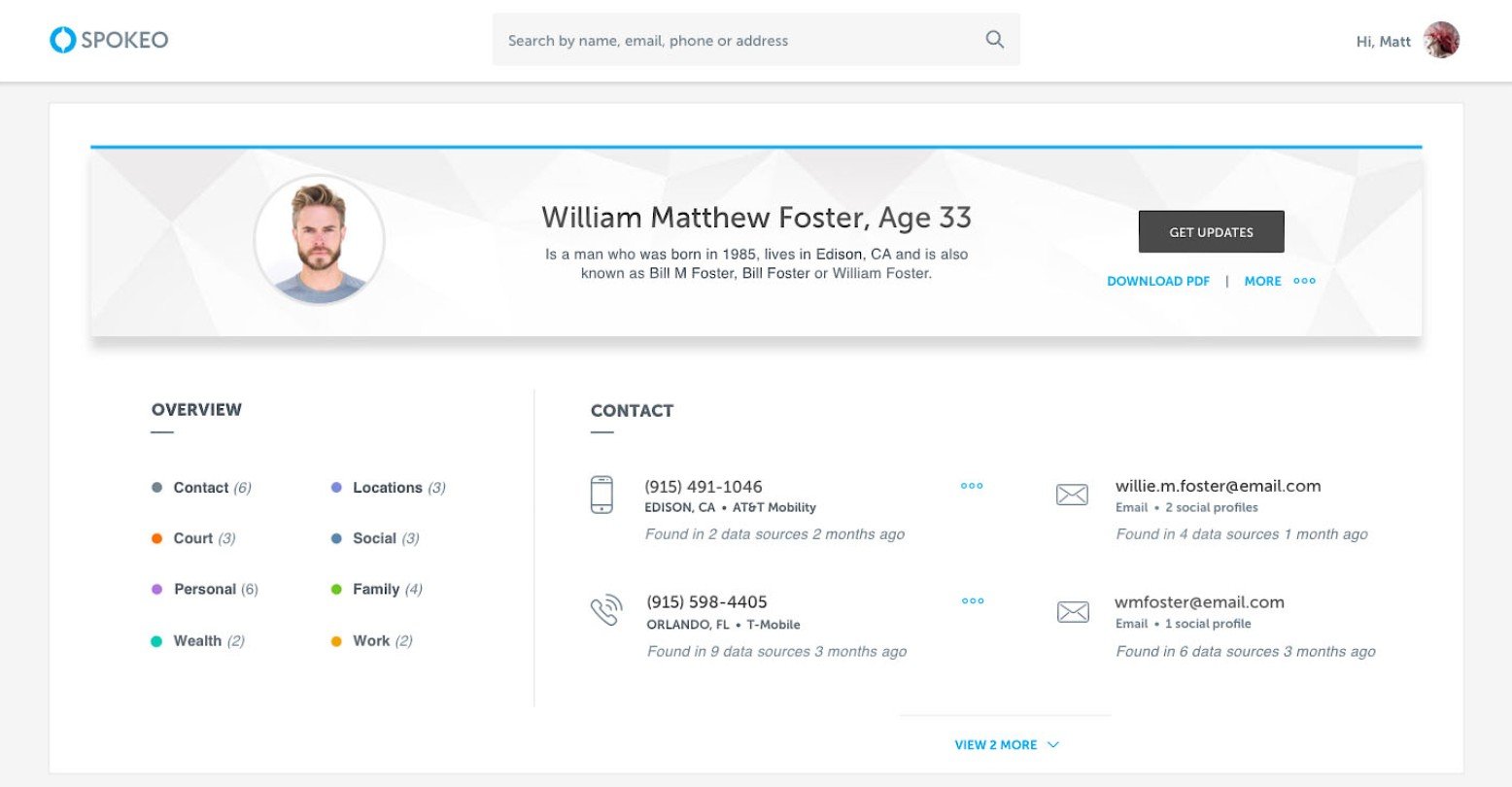
Spokeo is an aggregator. It doesn't hold original records — it indexes and cross-matches material that already exists across public records, phone directories, property and court filings, marketing databases, and publicly visible social profiles, then tries to link those fragments to a single identity.
You can search five ways: by name, phone number, email address, physical address, or username. A free search returns a teaser — typically an approximate age, a city and state, and perhaps a couple of possible relatives — with the full report behind payment. A paid report can include contact details, address history, possible relatives and associates, and public-record style information, though what actually appears varies enormously from person to person depending on what exists and what Spokeo has managed to match.
Reverse phone lookup is the feature that works best in practice and drives most of the genuine satisfaction with the service — mapping a number to a probable owner is a well-defined problem with reasonably good data behind it. Court and criminal record searches are offered as a paid add-on beyond the standard subscription rather than being bundled, and come with the FCRA caveat above attached.
Note the ceiling: consumer subscriptions are capped at 100 searches per month. That's ample for personal use and a hard constraint for anyone imagining bulk work.
How Accurate Is It? Set Your Expectations Low
Because Spokeo aggregates rather than originates, its accuracy inherits every flaw in its sources — and public records go stale constantly. The recurring complaints are consistent across review platforms: addresses from three moves ago, phone numbers since reassigned to a stranger, employment and relationship data that hasn't been true for years. Spokeo does not guarantee accuracy and characterises its output as a reference point rather than a verified record.
There's a notable piece of evidence here that most reviews miss. Spokeo was the defendant in Spokeo, Inc. v. Robins, a case that reached the US Supreme Court in 2016 — and the underlying grievance was straightforward: a man alleged Spokeo's report about him was simply wrong about his marital status, his children, and his employment. The Supreme Court's ruling concerned the technical question of what injury lets someone sue, but the Ninth Circuit later held that a materially inaccurate report is itself a concrete harm. A decade of litigation began with this service getting a real person's life wrong.
The practical rule: treat every result as a lead requiring independent confirmation, never as proof of anything. If a Spokeo report would change how you treat a person, verify it somewhere else before you act.
Spokeo Pricing: Nobody Can Tell You What It Costs
We've reviewed a lot of software this year with confusing pricing. Spokeo is the only one that doesn't publish prices at all. Its own help centre states that subscription cost varies by duration, product selection, and promotions — meaning the figure you're shown at checkout depends on which offer you happened to land on.
Here's what's been reported across reputable sources during 2025–2026:
| Offer | Reported Price | What to Know |
|---|---|---|
| Free preview search | $0 | Teaser only — approximate age, city/state, possible relatives |
| Trial | ~$0.95 for 7 days | Auto-converts to a paid subscription |
| Quarterly plan | ~$44.85 upfront (~$14.95/mo) | Rebills every three months until cancelled |
| Monthly plan | ~$19.95–$29.95/mo | Post-trial conversion commonly reported at $24.95–$29.95 |
| Higher tiers | Up to ~$69.95/mo | More searches, not better data |
| Court records | Add-on | Charged beyond the standard subscription |
Compiled August 2026 from published third-party reporting and Spokeo's own help documentation. Because Spokeo does not publish a price list and varies offers by promotion, treat every figure here as indicative. The only reliable price is the one on your own checkout screen — read it before confirming.
- The trial is not a one-off purchase. This is the single biggest misunderstanding. Paying $0.95 to unlock one report enrols you in a subscription that begins charging when the trial ends.
- Cancellation has a hard deadline. Spokeo's policy requires cancellation before 11:59pm Pacific Time on the final day of your trial or paid period to stop the next charge. Set a reminder for day six of a seven-day trial.
- Cancellation friction is a recurring theme. Long hold times, unclear cancellation flows, and reports of continued billing after cancellation appear consistently in feedback from 2025 into 2026. Cancel in writing where you can and keep the confirmation.
- Higher tiers buy volume, not quality. Consumer tiers share the same core data; what changes is how many searches you get. Paying more does not get you better information about a person.
- Court records cost extra. If criminal or civil history is what you came for, budget for the add-on — and re-read the FCRA limits before you use any of it.
How to Remove Your Own Information From Spokeo
A significant share of people who search for Spokeo aren't looking to buy it — they've discovered their own address and relatives listed on a website and want it gone. That's a reasonable thing to want, and it's more achievable in 2026 than it has ever been.
The direct route (anyone, anywhere):
- Search for yourself on Spokeo and copy the URL of the listing that shows your information.
- Go to Spokeo's opt-out page, paste the listing URL, and provide an email address for confirmation.
- Confirm via the verification email. Removal is typically processed within a few days.
- Re-check periodically. Aggregators rebuild profiles as new records surface, so a listing removed today can reappear later. Diarise a check every few months.
The California route (a genuinely new option):
California's Delete Act created DROP — the Delete Request and Opt-out Platform — run by the state privacy regulator, CalPrivacy. California residents have been able to submit requests since 1 January 2026, and as of 1 August 2026 registered data brokers are legally required to retrieve and process those requests at least every 45 days. One verified request reaches every registered broker in the state rather than requiring you to chase each one individually. Signing up is free, identity is verified through the state's gateway, and your identifiers are stored hashed. Brokers that ignore requests face civil penalties reported at $200 per day per unfulfilled request, with a dedicated enforcement team at the agency.
- Removal from one site is not removal from the category — dozens of aggregators carry overlapping data, so treat this as an ongoing task rather than a one-off.
- California residents should use DROP, which reaches every registered broker at once and now carries enforcement behind it.
- Many US states run address confidentiality programmes for people at risk from stalking or domestic abuse, which substitute a legal proxy address on public records at the source.
- If you're in immediate danger, a domestic violence advocate can help with a removal plan far more comprehensively than any single opt-out form. That's a better first call than a privacy tool.
Longer term, the way to appear in fewer of these databases is to feed them less: a privacy-respecting email provider like Proton Mail or Fastmail with per-service aliases makes cross-matching your identity meaningfully harder, and keeping sensitive documents in encrypted storage such as Tresorit keeps them out of the breach pipelines these profiles are partly built from.
How Spokeo Compares
| Factor | Spokeo | FCRA Background Checks | B2B Contact Databases |
|---|---|---|---|
| Legal for hiring/tenants | No | Yes, with consent | No |
| Subject consent required | None | Yes | None |
| Dispute rights | None | Statutory | None |
| Data focus | Private individuals | Verified records | Work contacts only |
| Typical cost | Under $30/mo | $30–$100 per check | Subscription |
| Accuracy guarantee | Explicitly none | Regulated standards | Varies |
Who Spokeo Is Genuinely Useful For
- Anyone fielding unknown calls. Reverse phone lookup is the service's strongest feature and the most common reason people report a good experience.
- Online dating safety checks. Confirming that a match's name, approximate age, and city line up before meeting a stranger is a sensible precaution — one that safety advice has recommended for years. Verification, not investigation.
- People reconnecting with family. Adoptees, estranged relatives, and old friends are the use case Spokeo's own help documentation leads with, and address history is exactly what that job needs.
- Genealogists. Relative-mapping across shared addresses and surnames is useful for building out a family tree, especially for recent generations that predate digitised records.
- Private-party transactions. Confirming that the person selling you a car is who they say they are before you hand over cash is a reasonable, proportionate check.
Who Should Not Use It
- Employers and landlords. Not a judgment call — using Spokeo for these decisions falls outside the FCRA framework that governs them. Use a compliant agency.
- Anyone needing certainty. If being wrong would have real consequences for you or the person you're searching, this data isn't built to carry that weight.
- Anyone tempted to monitor a person. The line between verifying someone and surveilling them is not blurry, and a subscription that permits a hundred searches a month makes crossing it easy.
- Sales and recruitment teams. Purpose-built B2B databases are more accurate for work contacts, cheaper at volume, and don't involve compiling profiles of private individuals.
- People outside the US. Coverage is overwhelmingly American; results elsewhere are thin to non-existent.
Limitations & Reality Check
- Unpublished pricing is a genuine consumer problem. You cannot compare a service you can't get a price for, and varying offers by promotion means two people pay different amounts for the same thing.
- Free means teaser, not free. The no-cost search shows just enough to confirm a record exists, which is the funnel working as designed rather than a usable result.
- Data quality is structurally capped. No aggregator can be more current than its sources, and public records lag reality by months or years.
- The regulatory ground is moving. California's enforcement began this month, other states are following, and the compliance burden on this whole category is rising. Expect the product and its pricing to change.
- Deleting yourself is a chore by design. Per-site opt-out forms exist because they're the minimum required, and profiles rebuild themselves as new records surface.
- Support experience is inconsistent. Billing and cancellation complaints span years and platforms. Pay with a method you can dispute, and keep every confirmation.
Best Practice: One Question, One Month, Then Out
Frequently Asked Questions
How much does Spokeo cost?
Spokeo does not publish a price list — its help centre states cost varies by subscription duration, product selection, and promotions. Reported figures include a trial around $0.95, a quarterly plan around $44.85 upfront (roughly $14.95 a month), monthly subscriptions commonly between $19.95 and $29.95, and higher tiers up to about $69.95. Court records are a paid add-on. The only reliable price is the one shown on your own checkout screen.
Is the Spokeo trial really $0.95?
The trial charge itself is small, but it is not a one-off purchase. It enrols you in a subscription that begins billing when the trial ends — commonly reported at $24.95 to $29.95 a month. Spokeo's policy requires cancellation before 11:59pm Pacific Time on the final day to prevent the next charge. This conversion is the single most common complaint about the service.
Can I use Spokeo for a background check on an employee or tenant?
No. Spokeo is not a consumer reporting agency and states that its data may not be used for decisions about employment, tenant screening, credit, insurance, or any other purpose requiring Fair Credit Reporting Act compliance. Those decisions require a genuine FCRA-compliant agency, which involves the subject's consent and gives them the right to dispute inaccurate information.
Is Spokeo accurate?
Inconsistently. Because it aggregates rather than originates data, accuracy depends entirely on its sources, and common complaints involve outdated addresses, reassigned phone numbers, and stale employment or relationship information. Spokeo does not guarantee accuracy and describes its output as a reference point rather than a verified record. Treat results as leads to confirm independently, not as facts.
How do I remove my information from Spokeo?
Search for yourself, copy the URL of the listing showing your details, submit it through Spokeo's opt-out page with an email address, and confirm via the verification email. Removal typically processes within a few days. Re-check periodically, because aggregated profiles can rebuild as new records surface. California residents can instead use the state's DROP platform to reach every registered data broker with one request.
What is DROP and can it delete my Spokeo listing?
DROP — the Delete Request and Opt-out Platform — is a free service run by California's privacy regulator under the Delete Act. California residents have been able to submit deletion requests since 1 January 2026, and since 1 August 2026 registered data brokers must retrieve and process those requests at least every 45 days. One verified request reaches every registered broker in the state, with reported civil penalties of $200 per day for each unfulfilled request.
Is Spokeo legal?
Yes. Aggregating and selling publicly available information is legal in the United States, and Spokeo has operated for many years. What's restricted is how you use the results: FCRA-regulated decisions such as hiring, tenant screening, credit, and insurance are off limits. Spokeo was also the defendant in a 2016 Supreme Court case, Spokeo v. Robins, which arose from a report alleged to contain false information about a private individual.
How many searches can I run?
Consumer subscriptions are capped at 100 searches per month. Higher-priced tiers generally provide more search volume rather than better or deeper data — paying more does not improve the accuracy of what you find.
Final Verdict
Spokeo works best when you approach it with a narrow, specific, personal question and low expectations. Identifying an unknown caller, confirming a stranger is who they claim before you meet them, or picking up the trail of a relative who moved three times — these are real jobs and it does them reasonably well for a few dollars. Reverse phone lookup in particular is genuinely useful.
Everything else about the service argues for caution. The pricing isn't published, the cheap trial auto-converts into the subscription that generates most of its complaint history, the data carries no accuracy guarantee from a company that litigated to the Supreme Court over an allegedly false report, and an entire category of obvious uses — hiring, renting, credit, insurance — is legally off limits. If you use it, buy one month deliberately, run your searches in a single sitting, set a cancellation reminder before the Pacific-time deadline, and verify anything that matters somewhere else. And if you came here because you found yourself on Spokeo, skip the purchase entirely and use the opt-out steps above — Californians in particular now have real enforcement behind that request for the first time.
Run a Free Preview Search on Spokeo →