


Building a standard e-commerce store is simple. Building a two-sided marketplace (like Airbnb, Fiverr, or Etsy) is notoriously complex. You have to handle multi-vendor onboarding, split payments, escrow logic, and cross-party communication. For years, founders had two options: hack together a dozen fragile WordPress plugins, or raise $50,000 to hire a custom development agency.
Sharetribe was engineered specifically to solve this bottleneck. It promises to let you launch a fully functional, scalable marketplace using a no-code visual builder, while offering a "headless" API for deep customization down the road. But does it actually scale when transaction volume spikes? In this Sharetribe technical audit, we strip down their database architecture, Stripe integrations, and developer CLI to see if it truly replaces custom code.
- No-Code to Pro-Code: Sharetribe offers a visual builder to launch your MVP in days, backed by a developer API (Sharetribe CLI) that allows custom code scaling.
- Built for Marketplaces: Natively handles complex multi-vendor logic including split payments, escrow, user reviews, and advanced search filtering.
- Stripe Connect Integration: Resolves the hardest part of a marketplace—legal payment routing—by deeply integrating with Stripe for instant vendor payouts.
- The Cost Reality: Extremely cheap to build ($39/mo), but pricing scales to $139/mo (or $99/mo annually) when you launch on the Lite plan, plus transaction fees.
1. Quick Summary
2. The TL;DR Verdict
The End of Custom Development
Sharetribe eliminates the technical friction of launching a multi-vendor platform. Instead of spending months wrestling with WooCommerce vendor plugins or learning Bubble's complex database architecture, Sharetribe provides the exact data structure needed for supply and demand out of the box. Its hybrid approach—starting no-code and scaling with React templates via CLI—makes it the most logically sound infrastructure for non-technical founders.
Start Building Your Marketplace Free →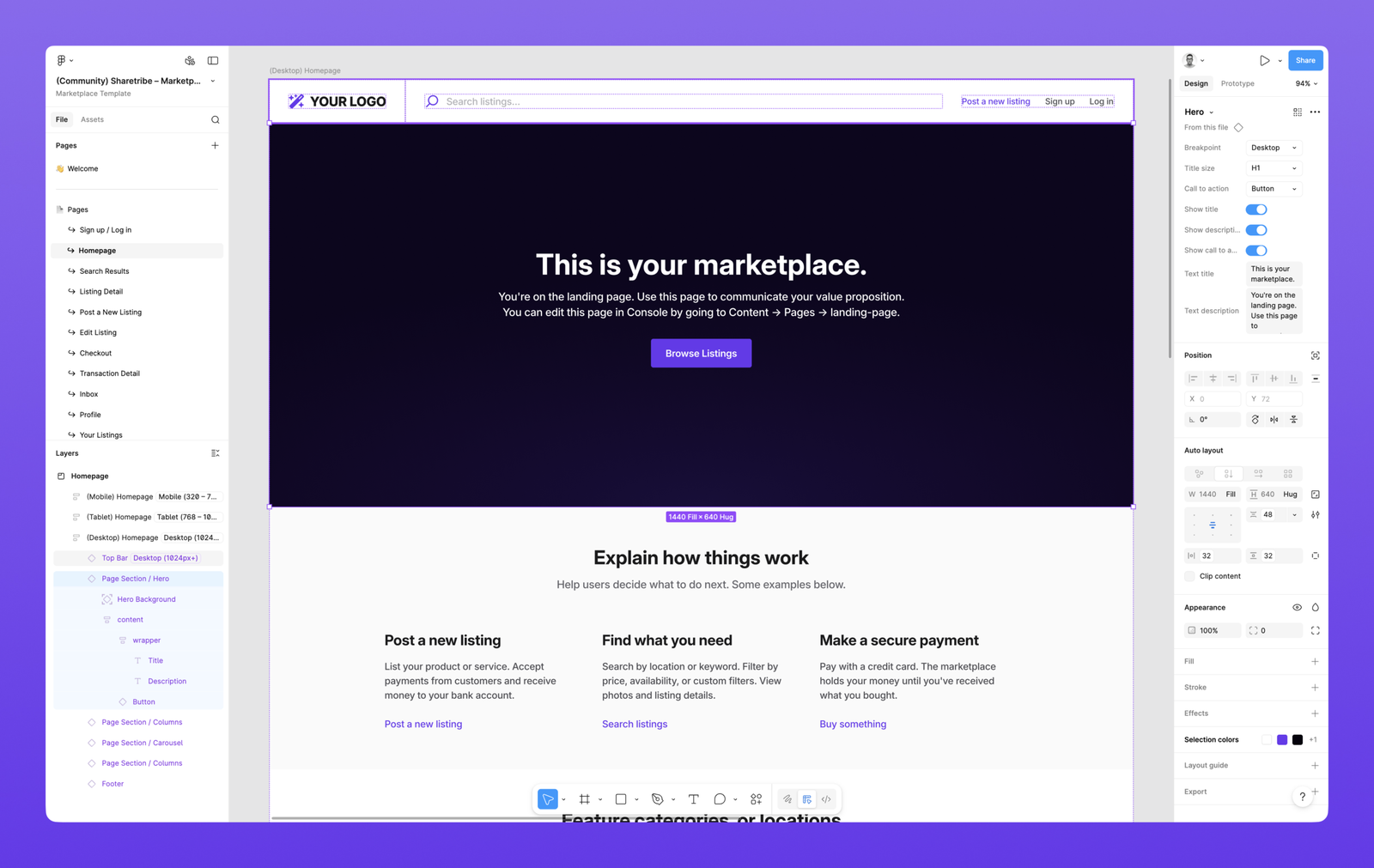
3. How We Evaluated Sharetribe
To ensure an objective operational audit, we deployed Sharetribe to simulate a live "Peer-to-Peer Equipment Rental" marketplace over a 30-day sandbox phase. Our evaluation process included:
- Financial Routing: Testing Stripe Connect flows, including delayed escrow payouts, custom commission percentage splits, and vendor onboarding constraints.
- Data Liquidity: Creating 500 dummy "listings" to stress-test the native search algorithms, map filtering, and categorical indexing speeds.
- Developer Extensibility: Accessing the Sharetribe CLI to evaluate how seamlessly a developer could inject a custom React component into the front-end template.
- Cost Analysis: Comparing the total cost of ownership over 24 months against a Bubble.io build and a custom-coded MERN stack.
4. What Sharetribe Actually Does
Sharetribe provides the backend database and front-end interface specifically wired for multi-user transactions.
If you want to build a platform where User A rents a camera to User B, Sharetribe handles the onboarding of User A, the display of their listing, the search interface for User B, the secure collection of payment, the calculation of your platform's commission, and the eventual payout to User A once the rental is complete. It is the operating system for your marketplace business model.
5. Core Features Matrix
6. The Data: The Cost of Custom Marketplace Builds
Founders frequently underestimate the complexity of split-payment architectures and two-sided databases. Here is the financial reality of launching a marketplace MVP.
7. Technical Setup: Headless vs No-Code
Sharetribe's architecture is brilliant because it scales with your revenue.
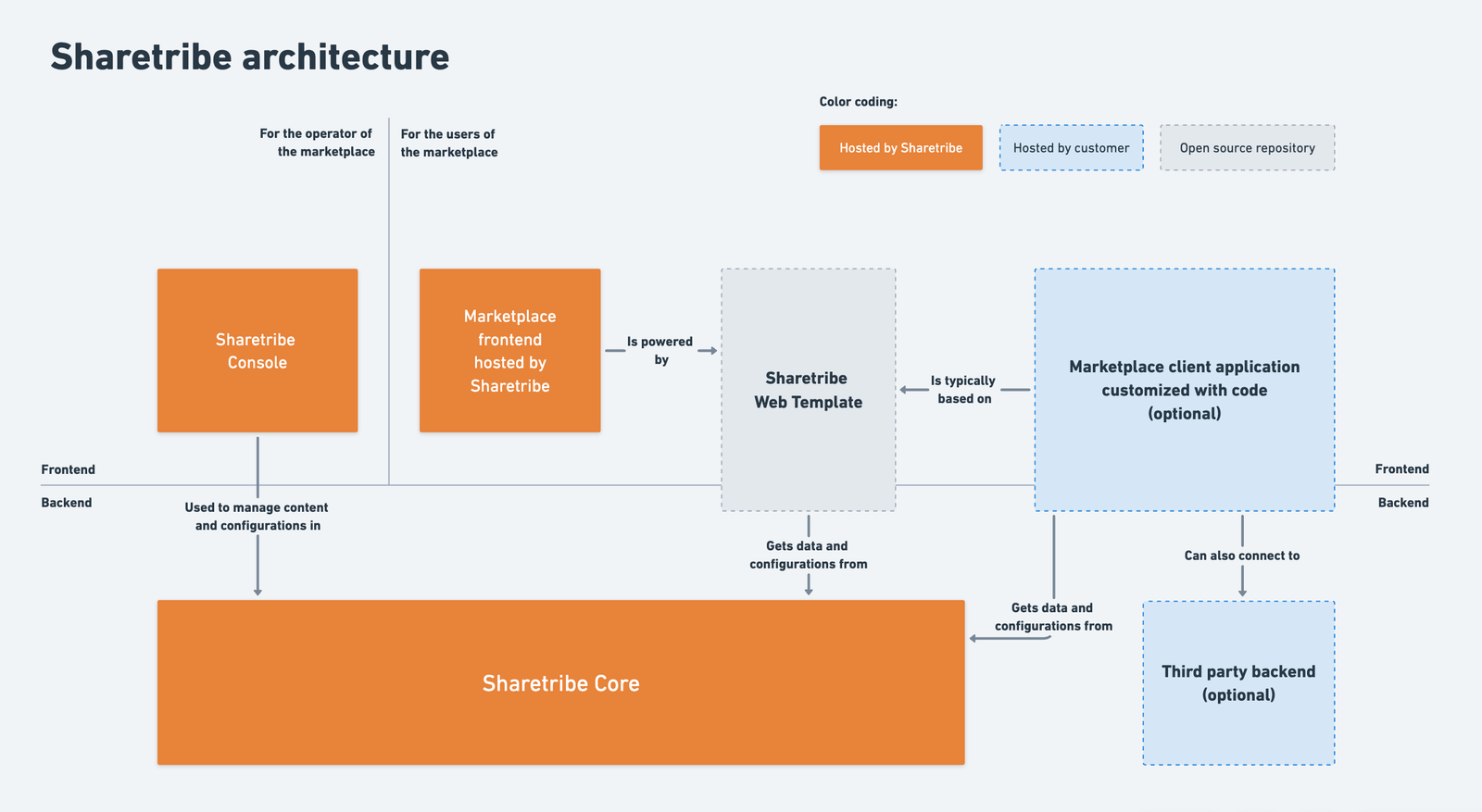
You begin with their No-Code Builder. This gives you a polished, hosted web application where you can customize branding, layout, and listing data fields via a visual dashboard. However, as your marketplace grows, you will inevitably hit the limits of a visual builder. Sharetribe solves this by offering a Headless API. Your backend data remains intact, but you can hire a developer to download their open-source React web template, customize the code entirely, and deploy a bespoke front-end without having to rebuild the database or payment routing.
8. Workflow & Deployment Timeline
Here is what the execution pipeline looks like for deploying a Service Marketplace:
Step 1: Data Architecture
Use the visual builder to define "Listing Types" (e.g., hourly services) and "Transaction Processes" (e.g., Request -> Accept -> Pay -> Review).
Step 2: Financial Routing
Connect your Stripe account. Define your platform's commission structure (e.g., charge a 10% fee to the provider, and a $2 flat fee to the buyer).
Step 3: Frontend Design
Upload brand assets, customize the search bar filters, and configure the layout of the provider profiles and listing pages.
Step 4: MVP Launch
Upgrade to the "Lite" plan, connect your custom domain, and onboard your initial 50 service providers to test market liquidity.
9. Feature Focus: Stripe Connect Payments
Handling money in a marketplace is a legal and technical minefield. If you hold funds in your own bank account before paying a vendor, you may violate KYC (Know Your Customer) and anti-money laundering laws. Sharetribe bypasses this by deeply integrating with Stripe Connect. Funds are held securely in Stripe's escrow, your commission is automatically extracted, and the vendor is paid out directly. Sharetribe's implementation of this API is flawless and saves weeks of coding.
10. Feature Focus: Search & Filtering
A marketplace is useless if buyers cannot find exactly what they want. Sharetribe's native search engine supports keyword searches, location-based map radii, calendar availability (crucial for rentals/services), and custom extended data fields (e.g., filtering a car rental by "Electric" or "Gas"). This runs incredibly fast out of the box.
11. Transactional API & Headless Scaling
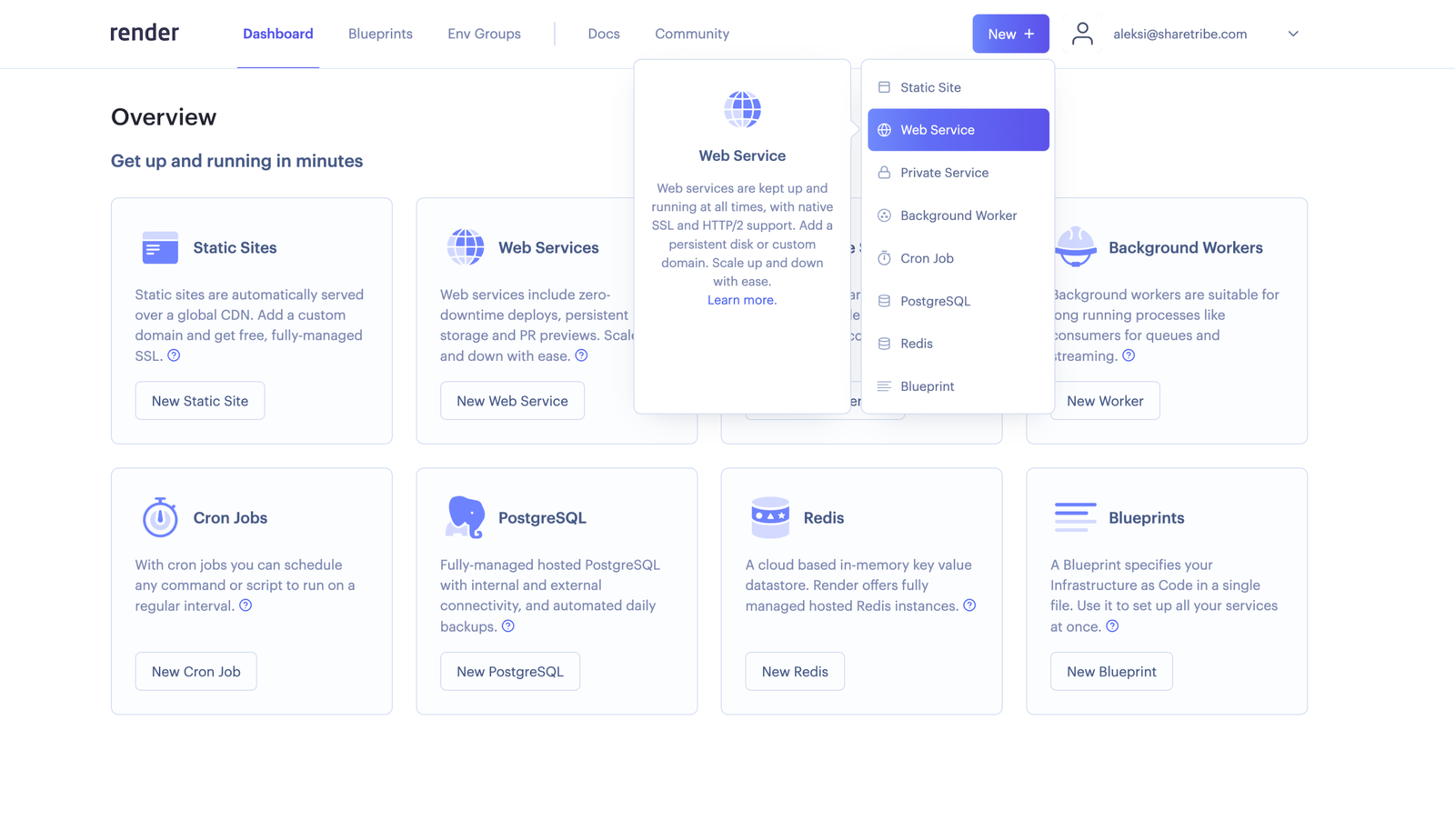
If you outgrow the visual builder, you are not trapped. The Sharetribe Developer Platform gives you complete access to the Integration API. You can write custom server-side scripts (e.g., syncing your marketplace data with an external CRM, or triggering custom SMS notifications via Twilio when a booking is confirmed) without disrupting the core marketplace engine.
12. Example Use Cases
13. The Real ROI (Capital Conservation)
Hover over the metrics below to see the baseline operational advantages of using Sharetribe.
Custom coding a stable multi-vendor payment system takes months of developer time. Sharetribe provides it instantly, allowing you to focus on marketing.
You do not have to pay a developer retainer to maintain servers, update security patches, or fix breaking API changes. Sharetribe handles the infrastructure.
14. Who Sharetribe Is Best For
- Non-Technical Founders: If you need to validate a marketplace idea quickly without writing code, this is the safest, most robust option.
- Bootstrapped Startups: Retaining your capital to spend on acquiring users (marketing) rather than blowing your entire budget on a custom app build.
- Developers Seeking Speed: Even if you can code, utilizing Sharetribe's backend API and customizing their React template is infinitely faster than building a database from scratch.
15. Who Should Avoid Sharetribe
- Single-Vendor Stores: If you are just selling your own products, do not use Sharetribe. Use Shopify. This platform is strictly for multi-vendor (many sellers, many buyers) logic.
- Hyper-Custom Logic Requirements: If your marketplace requires highly unorthodox transaction flows (e.g., a three-way bidding auction system with blind escrows) that fall outside Sharetribe's standard logic, you will need a custom build.
16. Integration Ecosystem & Synergy
17. Real User Sentiment (G2 & Trustpilot)
Across software review boards, Sharetribe maintains an exceptionally high reputation among founders:
- The Praise: The overwhelming consensus highlights the stability of the platform. Unlike WordPress multi-vendor plugins (which break constantly upon updating), Sharetribe's hosted environment is virtually bulletproof.
- The Complaints: The primary critique centers on the pricing jump. While $39/mo to build is cheap, transitioning to the $139/mo "Lite" plan ($99/mo billed annually) which still includes transaction fees feels steep for pre-revenue founders. Furthermore, heavy aesthetic customization requires hiring a developer to use the CLI.
18. Pricing Realities & Feature Tiers
Sharetribe splits its pricing into two phases: Building and Live.
Build Plan
- Full access to No-Code builder
- Access to Developer CLI & APIs
- Test transactions in sandbox
- Cannot invite real paying users
Lite Plan
- Accept real payments via Stripe
- Connect custom domain name
- Remove Sharetribe branding
- Includes a % transaction fee
19. The Hidden Costs & Transaction Fees
It is vital to model your margins. On the Lite plan, Sharetribe takes a transaction fee on every sale (in addition to standard Stripe processing fees). As your GMV (Gross Merchandise Value) grows, you must mathematically upgrade to the Pro ($199/mo) or Extend ($299/mo) plans to lower these transaction fees, ensuring your platform remains profitable at scale.
20. Best Practices: "The Alpha Plan"
Do not hire a developer on day one. You must execute the Alpha Plan to protect your capital.
21. Security & Compliance
Because Sharetribe relies entirely on Stripe Connect, your servers never touch sensitive credit card data, making you instantly PCI compliant. Sharetribe itself utilizes enterprise-grade infrastructure, handling data encryption, GDPR compliance (with built-in data deletion requests), and server uptime so you don't require an in-house DevOps engineer.
22. How Sharetribe Compares
| Feature | Sharetribe | Bubble.io | WordPress (WooCommerce) |
|---|---|---|---|
| Marketplace Logic | Pre-Built (Native) | Must build from scratch | Requires clunky plugins |
| Learning Curve | Low (No-Code MVP) | Very Steep | Moderate |
| Developer Scaling | Excellent (React/CLI) | Closed Ecosystem | PHP limits |
| Stripe Connect | Flawless Integration | Requires API coding | Prone to breaking |
23. PROS & CONS
- Launches a robust, secure two-sided marketplace in days, not months.
- Flawless Stripe Connect integration handles escrow and split payouts.
- Hybrid architecture allows scaling from no-code MVP to custom React code.
- Saves tens of thousands of dollars in initial development costs.
- The jump from $39/mo to $139/mo upon launch is a hurdle for bootstrappers.
- Lower tiers incur transaction fees on top of standard Stripe fees.
- Deep UI customization strictly requires developer intervention via CLI.
Watch our deep-dive visual teardown of the Sharetribe backend and Stripe flow.
24. Frequently Asked Questions
1. Is Sharetribe better than building on WordPress?
Yes. Building a marketplace on WordPress requires stringing together multiple multi-vendor plugins, caching systems, and payment gateways. It is notoriously fragile and breaks frequently. Sharetribe is a dedicated, hosted infrastructure built specifically for marketplace logic.
2. Do I need to know how to code?
No. You can launch a fully functional, branded marketplace using only their No-Code visual builder. Coding is only required if you want to heavily alter the frontend UI or build highly custom backend integrations later on.
3. How do vendors get paid?
Sharetribe natively integrates with Stripe Connect. Buyers pay via credit card, the funds are held securely, your platform commission is extracted automatically, and the remainder is routed directly to the vendor's bank account.
4. Can I set my own commission rates?
Absolutely. You can define custom commission logic, such as a flat fee per transaction, a percentage of the total sale, or a combination of both (e.g., 10% + $0.50).
5. Can users message each other?
Yes, Sharetribe includes a native two-way messaging system allowing buyers and providers to communicate securely before and after a transaction is booked.
6. Does it support location-based searching?
Yes, map integrations and location-based search radii are built into the core search engine, making it perfect for local service platforms or rental marketplaces.
7. What is the Sharetribe Developer Platform?
It is a headless architecture. It gives developers access to Sharetribe's APIs, SDKs, and a customizable React web template (Sharetribe Web Template) so they can build a completely bespoke frontend while utilizing Sharetribe's backend database.
8. Can I migrate off Sharetribe later?
While your custom frontend code (if you use the React template) is yours, the core database and payment routing remain on Sharetribe's servers. Migrating entirely would require exporting your user data via API and rebuilding the backend logic elsewhere.
25. Final Verdict
Attempting to hard-code a marketplace MVP from scratch in 2026 is an unnecessary drain on capital and operational bandwidth. The technical complexities of handling split payments, user escrows, and two-sided search queries destroy most startups before they even launch.
Sharetribe is the definitive solution to this problem. By offering a no-code visual builder for rapid market validation, backed by a robust headless developer API for unlimited future scaling, it acts as the perfect technical bridge. It allows founders to stop worrying about database architecture and focus entirely on what actually matters: acquiring buyers and sellers.
Deploy Your Marketplace Infrastructure Today →